Green Bottle Blue Care Guide: Enclosure, Diet & Molting
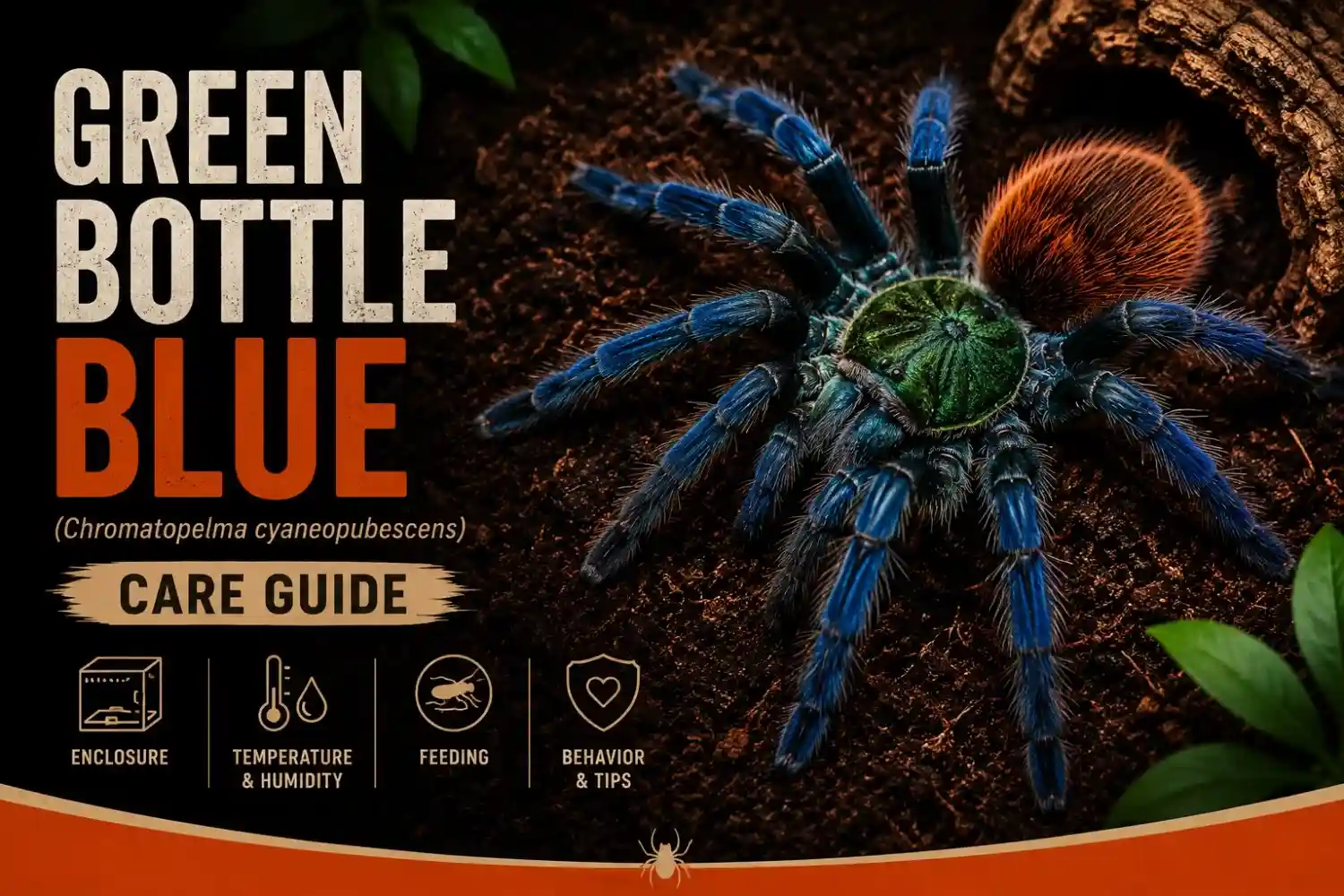
The Green Bottle Blue Tarantula, commonly called the GBB, is one of the most eye-catching species in the hobby. Its metallic blue legs, green-blue carapace, orange abdomen, and thick web tunnels make it look almost unreal. This species is also popular because it is usually active, hardy, fast-growing, and visible outside its hide.
A settled GBB often sits near the entrance of its silk tunnel, waiting for prey vibrations. However, simple care does not mean careless care. The GBB still needs a secure terrestrial enclosure, strong ventilation, suitable web anchors, clean water, and protection from dangerous falls. This guide covers Green Bottle Blue tarantula care, including enclosure size, substrate, moisture, feeding, webbing, molting, temperament, cleaning, and safe rehousing.
Green Bottle Blue Quick Facts
| Care category | Information |
|---|---|
| Scientific name | Chromatopelma cyaneopubescens |
| Common name | Green Bottle Blue Tarantula |
| Native range | Venezuela |
| Type | New World terrestrial, heavy-webbing species |
| Adult size | Around 5–6 inches |
| Female lifespan | About 12–15 years |
| Male lifespan | About 3–5 years |
| Growth rate | Medium to fast |
| Temperament | Fast, skittish, and usually defensive only when disturbed |
| Experience level | Beginner to intermediate |
| Enclosure style | Wide terrestrial setup with web anchors |
| Temperature | Around 70–78°F |
| Moisture | Mostly dry for larger specimens |
| Handling | Not recommended |
These figures are useful starting points. Individual growth, appetite, behavior, and lifespan can vary.
What Is a Green Bottle Blue Tarantula?
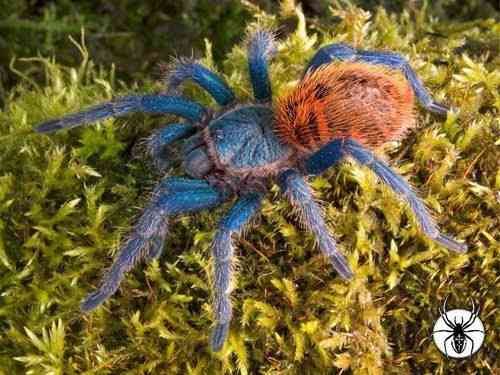
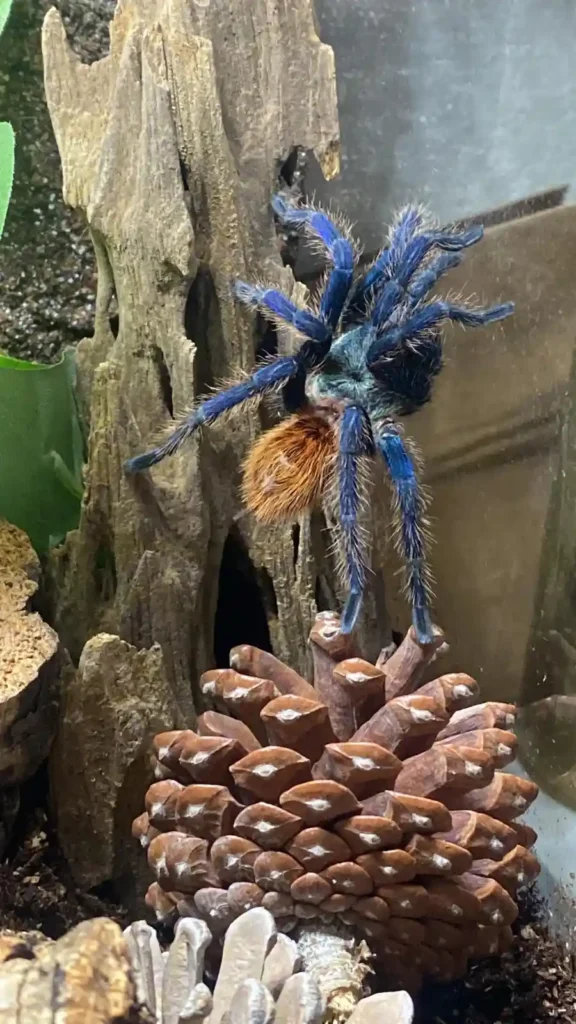
The Green Bottle Blue belongs to the genus Chromatopelma. Its scientific name is Chromatopelma cyaneopubescens. It is currently the only recognized species in this genus. The name suits the spider well because adults develop bright blue legs, a green or blue-green carapace, and an abdomen covered in orange hairs.
The species comes from Venezuela, especially the dry northern region around the Paraguaná Peninsula. In the wild, it creates heavily webbed shelters around soil, vegetation, roots, and natural debris. The GBB is popular because it combines bright color with interesting behavior. Unlike many tarantulas that remain hidden for long periods, a settled GBB is often visible and actively expands its web network.
Green Bottle Blue Appearance and Colour Changes
A GBB is attractive at every life stage. Its appearance changes noticeably as it grows.
Spiderling Appearance
Small slings usually have:
- Dark legs with lighter markings
- A patterned abdomen
- Orange or pinkish abdominal colors
- A brighter appearance than many common tarantula slings
Juvenile Appearance
As the spider grows, blue color begins appearing more strongly on the legs. The carapace becomes greener, while the abdomen develops a darker base with bright orange hairs.
Juveniles may look especially vivid after molting.
Adult Appearance
Adult Green Bottle Blues normally show:
- Metallic blue legs
- A green or aqua-blue carapace
- A dark abdomen with orange hairs
- Long sensory hairs across the body
- Strong contrast between the legs and abdomen
Colors may appear duller before a molt and much brighter afterward.
Green Bottle Blue Size, Growth Rate and Lifespan
Most adult GBBs reach approximately 5–6 inches in diagonal leg span. They generally grow faster than slow-growing tarantulas such as many Grammostola and Brachypelma species. Growth depends on temperature, feeding, sex, genetics, and individual health.
Young specimens may molt several times during their first year. As the tarantula becomes larger, the time between molts usually increases. Females may live around 12–15 years under good care. Males usually have much shorter lives and may survive only 3–5 years, especially after reaching maturity.
Natural Habitat
The Green Bottle Blue comes from a dry and open region of Venezuela. Its habitat includes scrubland, rocky ground, low vegetation, roots, and natural debris. In the wild, it creates silk-lined shelters and web tunnels between the ground and nearby objects. This behavior explains why captive GBBs use cork bark, branches, plants, and enclosure walls as web anchors.
The natural habitat teaches two important care lessons:
- The enclosure should not remain constantly wet.
- The spider needs structure for web building.
The GBB is often described as a dry-environment tarantula, but that does not mean it should be kept without water. It still needs a clean water dish and careful moisture management, especially when young.
Is the Green Bottle Blue Good for Beginners?
The GBB is often recommended to beginners because its basic care is not difficult.
Its beginner-friendly qualities include:
- Strong appetite
- Medium-to-fast growth
- Simple moisture requirements
- Frequent visibility
- Hardy nature
- Impressive webbing
However, it is faster and more skittish than many traditional beginner species. A frightened GBB may bolt, retreat into its web, or kick urticating hairs. For this reason, it is better described as a beginner-to-intermediate species. A careful beginner can keep one successfully, but they should understand catch-cup use, escape prevention, and safe rehousing before moving the spider.
Is the GBB Terrestrial or Semi-Arboreal?
The Green Bottle Blue should generally be housed as a terrestrial tarantula. It has a heavy body and can be seriously injured if it falls from too much height. However, it also builds raised web tunnels around bark, branches, and plants. This is why some keepers informally describe it as semi-arboreal. The term refers to how it uses webbing structures, not to the type of enclosure it needs.
Correct GBB Setup
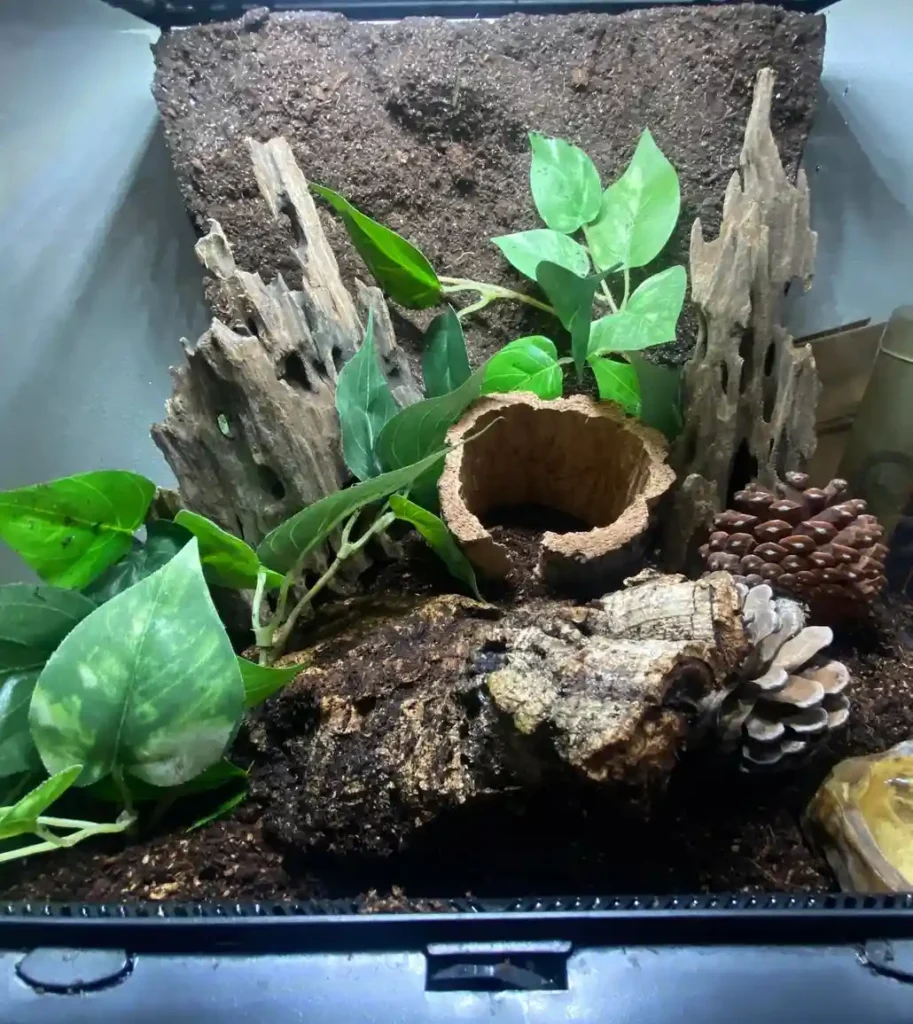
A safe enclosure should have:
- More width than height
- Enough substrate to reduce fall distance
- Cork bark placed at an angle
- Low branches or artificial plants
- Several webbing anchor points
Unsafe GBB Setup
Avoid:
- Tall arboreal enclosures
- Large empty climbing spaces
- Sharp rocks or decorations
- Hard objects directly below climbing areas
- Excessive distance between substrate and lid
Green Bottle Blue Enclosure Size by Life Stage
The enclosure should match the tarantula’s size.
| Life stage | Enclosure approach | Substrate | Important features |
|---|---|---|---|
| Small sling | Compact container around three times its leg span | Fill about one-half of the enclosure | Small hide, ventilation, and moisture in one corner |
| Juvenile | Wide terrestrial enclosure | Around one-third to one-half of enclosure height | Cork bark, water dish, and cross-ventilation |
| Adult | Secure horizontal enclosure with good floor space | Deep enough to reduce fall risk | Large hide, water dish, strong ventilation, and web anchors |
A small sling may struggle to find food in an oversized enclosure. An adult needs more space to build a large web network.
Complete Green Bottle Blue Enclosure Setup
1. Choose a Secure Horizontal Enclosure
Select an enclosure that is wider than it is tall. The lid must close securely because a GBB can move quickly and may escape through a small opening. Front-opening setups can work, but the door may become covered in silk. Top access is often easier if the lid does not damage the web each time it opens.
2. Add Suitable Substrate
Use substrate that is:
- Free from chemicals and fertilizers
- Stable when walked on
- Able to hold a shallow burrow
- Not muddy
- Not extremely dusty
Coco fiber, organic topsoil, peat-based mixes, and safe commercial tarantula substrates can work. Press the substrate gently so it feels firm. Loose, fluffy substrate may encourage wall climbing.
3. Reduce Fall Distance
Add enough substrate to limit the space between the surface and the lid. A large, well-fed tarantula can suffer a ruptured abdomen if it falls onto a hard object. The water dish, rocks, and decorations should not sit beneath dangerous climbing areas.
4. Install a Starter Hide
Place a curved piece of cork bark partly into the substrate. Create a shallow depression beneath it. The spider may use the hide, build around it, or completely cover it with silk. All these responses are normal.
5. Add Webbing Anchors
Useful anchors include:
- Cork bark
- Thin branches
- Artificial plants
- Lightweight plastic leaves
- Safe dried vegetation
Arrange them at different angles. Do not fill the entire enclosure because the spider needs open space to design its own web.
6. Provide a Water Dish
Juveniles and adults should always have access to clean water. Use a shallow, stable dish that is easy to refill. Do not remove it permanently if the spider covers it with silk or substrate. Clean and replace it.
7. Ensure Strong Ventilation
Cross-ventilation helps prevent stale air and recurring mold. Ventilation holes must be small enough to prevent escape. Good airflow is especially important when keeping one section of a sling enclosure slightly moist.
Temperature, Moisture and Ventilation
GBB care guides often give different temperature and humidity numbers. It is better to focus on stable conditions than chase one exact reading.
Temperature
A stable room temperature of around 70–78°F works well for most GBBs.
Avoid:
- Direct sunlight
- Heat lamps
- Radiators
- Hot windowsills
- Unregulated heat mats
- Sudden temperature changes
Adult Moisture
Juveniles and adults usually do well with:
- A mostly dry surface
- Clean drinking water
- Strong ventilation
- Occasional light overflow in one corner
Do not keep the entire enclosure wet.
Spiderling Moisture
Small slings dry out faster than adults. Keep most of the enclosure ventilated and relatively dry, but maintain a slightly moist corner or lower layer. The substrate should feel lightly damp, not soaked.
Do Green Bottle Blues Need Misting?
Heavy routine misting is unnecessary. Adding a small amount of water to one controlled section gives better moisture control.
Reading the Enclosure
| Condition | What you may notice | What to do |
|---|---|---|
| Too wet | Constant condensation, wet surface, or musty smell | Stop watering and improve airflow |
| Suitable | Mostly dry surface, clean dish, and no stale smell | Continue the same routine |
| Sling drying too fast | Moist corner becomes dry very quickly | Add a small amount of water |
| Poor airflow | Mold returns repeatedly | Check ventilation holes |
| Dish dries quickly | Warm room or small dish | Refill more often |
Green Bottle Blue Webbing Behaviour
Heavy webbing is one of the species’ main attractions. A settled GBB may cover cork bark, plants, substrate, and even the water-dish area with thick silk.
Why Do GBBs Web So Much?
The silk helps the spider:
- Build a secure retreat
- Detect prey vibrations
- Connect different parts of the enclosure
- Strengthen shallow burrows
- Create protected molting areas
How to Encourage Webbing
Provide several anchor points at different angles. Avoid a bare enclosure with only one flat hide. After rehousing, leave the layout unchanged. Some GBBs begin webbing quickly, while others need several weeks.
Why Is My GBB Not Webbing?
Possible reasons include:
- Recent rehousing
- Premolt
- Frequent disturbance
- Lack of anchors
- Wet or unstable substrate
- Individual behavior
Check the setup and give the spider time.
Why Does It Web Over the Water Dish?
The spider sees the dish as another useful structure. Clear enough silk to refill it, but do not destroy the whole tunnel.
Should Old Webbing Be Removed?
Healthy webbing should remain unless you need access to mold, waste, dead prey, or a dangerous object.
Green Bottle Blue Feeding and Diet
GBBs are usually strong feeders, but the schedule should change according to age, abdomen size, and premolt signs.
Suitable feeders include:
- Crickets
- Dubia roaches
- Red runner roaches
- Mealworms
- Superworms
- Locusts where legal
- Pre-killed insects for small slings
Feeding Schedule
| Life stage | Starting frequency | Suitable prey | Post-molt waiting |
|---|---|---|---|
| Small sling | Every 3–4 days or twice weekly | Tiny roach, pinhead cricket, or pre-killed prey | About 2–3 days |
| Juvenile | Every 7–10 days | Small or medium roach or cricket | Around 4–7 days |
| Adult | Every 10–21 days | Large cricket, roach, or similar insect | Around 7–10 days |
These are starting points, not fixed rules.
Judge the Abdomen
| Body condition | Feeding adjustment |
|---|---|
| Abdomen smaller than the carapace | Feed slightly more often |
| Abdomen similar in width | Keep the same routine |
| Abdomen moderately larger | Do not increase feeding |
| Abdomen extremely swollen | Reduce prey size or frequency |
Why Is My GBB Refusing Food?
Common reasons include:
- Premolt
- Recent rehousing
- Overfeeding
- Stress
- Seasonal changes
- Unsuitable prey
- Mature male behavior
Remove uneaten prey and keep water available.
Temperament, Urticating Hairs and Handling
Green Bottle Blues are usually skittish rather than highly defensive.
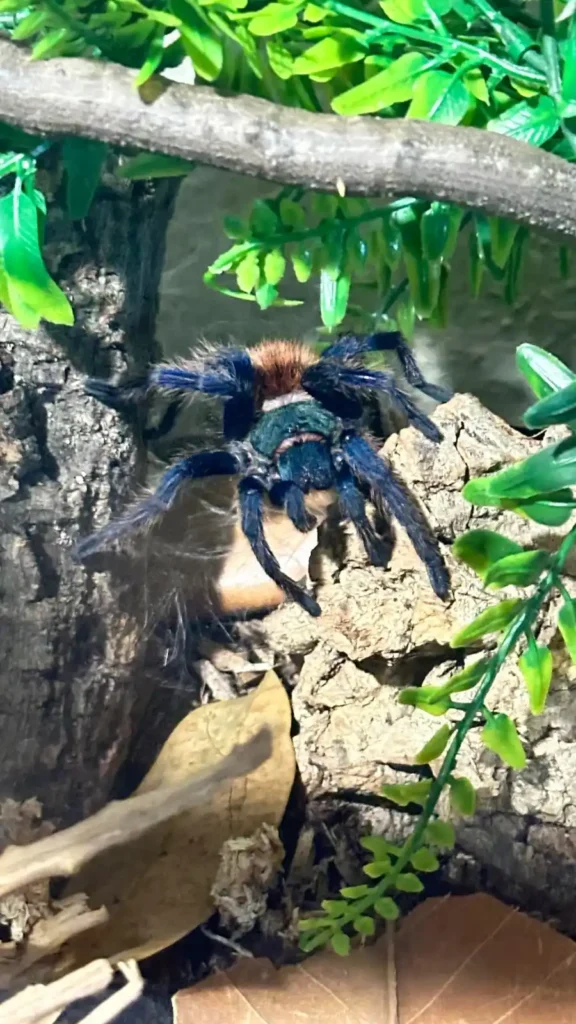
When disturbed, they may:
- Run into the web tunnel
- Bolt across the enclosure
- Kick urticating hairs
- Raise the front legs
- Strike
- Freeze
Urticating Hairs
The defensive abdominal hairs may irritate the skin, eyes, nose, or lungs.
After maintenance:
- Wash your hands.
- Avoid touching your face.
- Keep your face away from the open enclosure.
- Seek medical attention if hairs enter the eyes or cause a severe reaction.
Can You Handle a GBB?
Handling is not recommended. The greatest danger is often the tarantula bolting, falling, escaping, or becoming injured. Use a catch cup and long tools when movement is necessary.
Green Bottle Blue Molting Care
Molting is normal, but the tarantula becomes very vulnerable.
Signs of Premolt
A GBB may:
- Refuse food
- Move less
- Stay inside its tunnel
- Close entrances with silk
- Develop a dark abdomen
- Create a thick molt mat
- Appear duller in color
Remove live prey when these signs appear.
During the Molt
The tarantula may lie on its back. Do not turn it over.
Do not:
- Touch it
- Open the web tunnel
- Add prey
- Flood the enclosure
- Pull the old skin away
After the Molt
Keep water available and wait until the fangs become fully dark before feeding. Small slings may harden in a few days. Large adults may need more than a week.
How to Rehouse a Green Bottle Blue Safely
GBBs can bolt quickly, so preparation is essential.
Equipment Needed
Prepare:
- New enclosure
- Catch cup and lid
- Long soft brush
- Long feeding tongs
- Towels for blocking gaps
- Good lighting
Step 1: Prepare the New Enclosure
Complete the substrate, hide, water dish, and decorations before opening the old setup.
Step 2: Secure the Room
Close doors and windows. Remove pets and block large gaps where possible.
Work close to the floor or inside a large secondary container.
Step 3: Open the Old Enclosure Carefully
Find the tarantula’s position before moving the web.
When possible, move the cork bark together with the web retreat instead of forcing the spider out.
Step 4: Guide, Never Grab
Use a soft brush to touch the rear legs gently.
Never grab the spider with hands or tongs.
Step 5: Use the Catch Cup
If the GBB bolts, cover it with the cup and slide a thin lid underneath.
Step 6: Let It Settle
After the move, provide water and avoid unnecessary disturbance. Temporary hiding and food refusal are normal.
Cleaning and Maintenance
A heavily webbed enclosure should be cleaned carefully.
Daily Observation
Check:
- Enclosure security
- Water availability
- Tarantula position
- Escaped feeders
- Unusual condensation
- Obvious injury
After Feeding
Remove uneaten prey and visible food remains.
Weekly or As Needed
- Refill and clean the dish.
- Check ventilation.
- Remove visible waste.
- Inspect for mold.
- Confirm that decorations remain secure.
Does the Substrate Need Changing Every Year?
Not automatically.
A complete change may be needed when:
- Mold repeatedly returns
- Mites become excessive
- The substrate is contaminated
- The enclosure is damaged
- A leak saturates the setup
- The tarantula outgrows the enclosure
Otherwise, spot cleaning is less stressful.
Common Green Bottle Blue Problems and Solutions
| Problem | Possible reason | What to do |
|---|---|---|
| Not webbing | Recent rehouse, few anchors, or premolt | Improve the structure and allow time |
| Constant wall climbing | Wet or unstable substrate | Check moisture and press the substrate |
| Food refusal | Premolt, stress, or overfeeding | Remove prey and observe |
| Dish covered in silk | Normal behavior | Clear enough silk to refill |
| Mold | Excess moisture or food remains | Remove affected material and improve airflow |
| Hiding for weeks | Premolt or normal retreat | Do not dig it out |
| Frequent hair kicking | Too much disturbance | Reduce interaction |
| Bolting | Natural speed | Stop moving and use a catch cup |
| Very large abdomen | Overfeeding | Reduce feeding |
Common Green Bottle Blue Care Mistakes
Keeping the Enclosure Too Wet
A GBB does not need constantly soaked substrate.
Using a Tall Enclosure
Raised webbing does not make it a true arboreal species.
Providing No Web Anchors
A bare setup limits natural behavior.
Destroying Webs During Cleaning
Remove only what is necessary.
Feeding Only by Calendar
Observe abdomen size and premolt signs.
Feeding During Premolt
Live prey may injure a molting tarantula.
Removing the Water Dish
Fresh water should remain available.
Handling the Tarantula
Handling creates escape and fall risks.
Using Direct Heat
Heat lamps and unregulated mats may overheat the enclosure.
Rehousing Without Preparation
Always prepare the room, new enclosure, and catch cup first.
For more Information blogs click on this link : https://dragonsinfo.com/category/tarantulas/
Male vs Female Green Bottle Blue Tarantula
| Feature | Female | Male |
|---|---|---|
| Lifespan | Around 12–15 years | Around 3–5 years |
| Body | Usually heavier | Usually slimmer after maturity |
| Maturity | Often slower | Often faster |
| Adult behavior | Normal feeding and molting cycle | May wander and eat less |
| Sexing | Best confirmed through a molt | Mature features appear after the final molt |
Examining a suitable shed molt is usually the most reliable common method of sexing.
Green Bottle Blue Compared With Similar Display Tarantulas
| Feature | Green Bottle Blue | Antilles Pinktoe | Orange Baboon | Mexican Fireleg |
|---|---|---|---|---|
| Enclosure | Terrestrial with anchors | Arboreal | Terrestrial or fossorial | Terrestrial |
| Webbing | Very heavy | Moderate to heavy | Very heavy | Light |
| Speed | Fast | Moderate to fast | Very fast | Moderate |
| Temperament | Skittish | Often skittish | Highly defensive | Often defensive |
| Care level | Beginner-intermediate | Intermediate | Advanced | Beginner-intermediate |
| Main appeal | Color and web tunnels | Color changes | Speed and webbing | Red leg markings |
Frequently Asked Questions
Is the Green Bottle Blue good for beginners?
It can suit a careful beginner, but its speed makes it less forgiving than slower species.
How large does it grow?
Most adults reach about 5–6 inches.
How often should it be fed?
Feed according to age and abdomen condition. Slings eat more often than adults.
Does it need high humidity?
No. Larger specimens usually do well in a mostly dry enclosure with good ventilation and clean water.
Should I mist the enclosure?
Heavy routine misting is unnecessary. Add water to one controlled area when needed.
Why is my GBB not webbing?
It may be newly rehoused, in premolt, disturbed, or lacking anchor points.
Is it terrestrial or semi-arboreal?
Treat it as terrestrial while providing raised web anchors.
Can it be handled?
Handling is not recommended.
Why has it closed its web tunnel?
It may be preparing to molt, seeking privacy, or reacting to disturbance.
How long should I wait after a molt?
Wait until the fangs are fully dark and the body has hardened.
Does it need a hide?
Yes. A hide provides a secure starting point for web construction.
How often should the enclosure be cleaned?
Spot clean as needed. Complete substrate changes should only happen when necessary.
Conclusion
The Green Bottle Blue Tarantula is one of the most rewarding display species available. Its bright colors, strong feeding response, and extensive webbing make it exciting to keep. Successful care depends on a secure horizontal enclosure, stable substrate, limited fall distance, good ventilation, clean water, and several web anchors.
Remember the key points:
- Keep it in a terrestrial enclosure.
- Provide raised webbing anchors.
- Keep larger specimens mostly dry.
- Give slings a slightly moist area.
- Maintain strong ventilation.
- Feed according to body condition.
- Preserve healthy web tunnels.
- Never disturb a molt.
- Use a catch cup during rehousing.
- Avoid handling.
With the right setup and minimal disturbance, the GBB will create its own impressive silk-covered home.