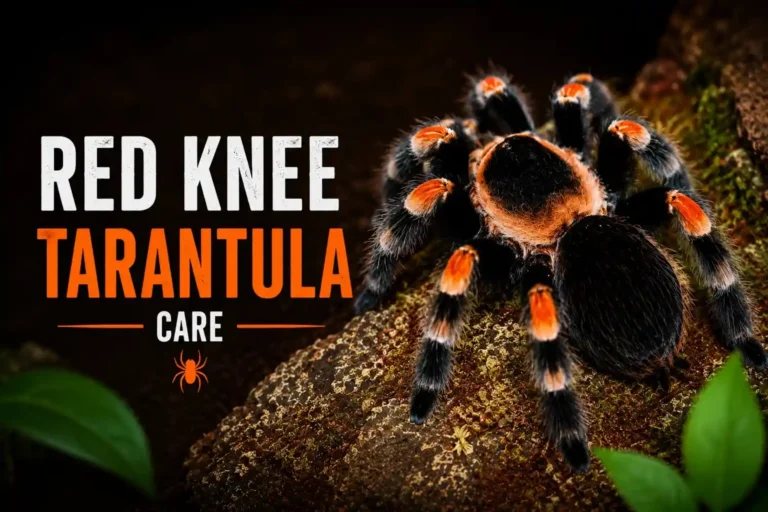
Mexican Pink Tarantula (Brachypelma klaasi): Full Care Guide
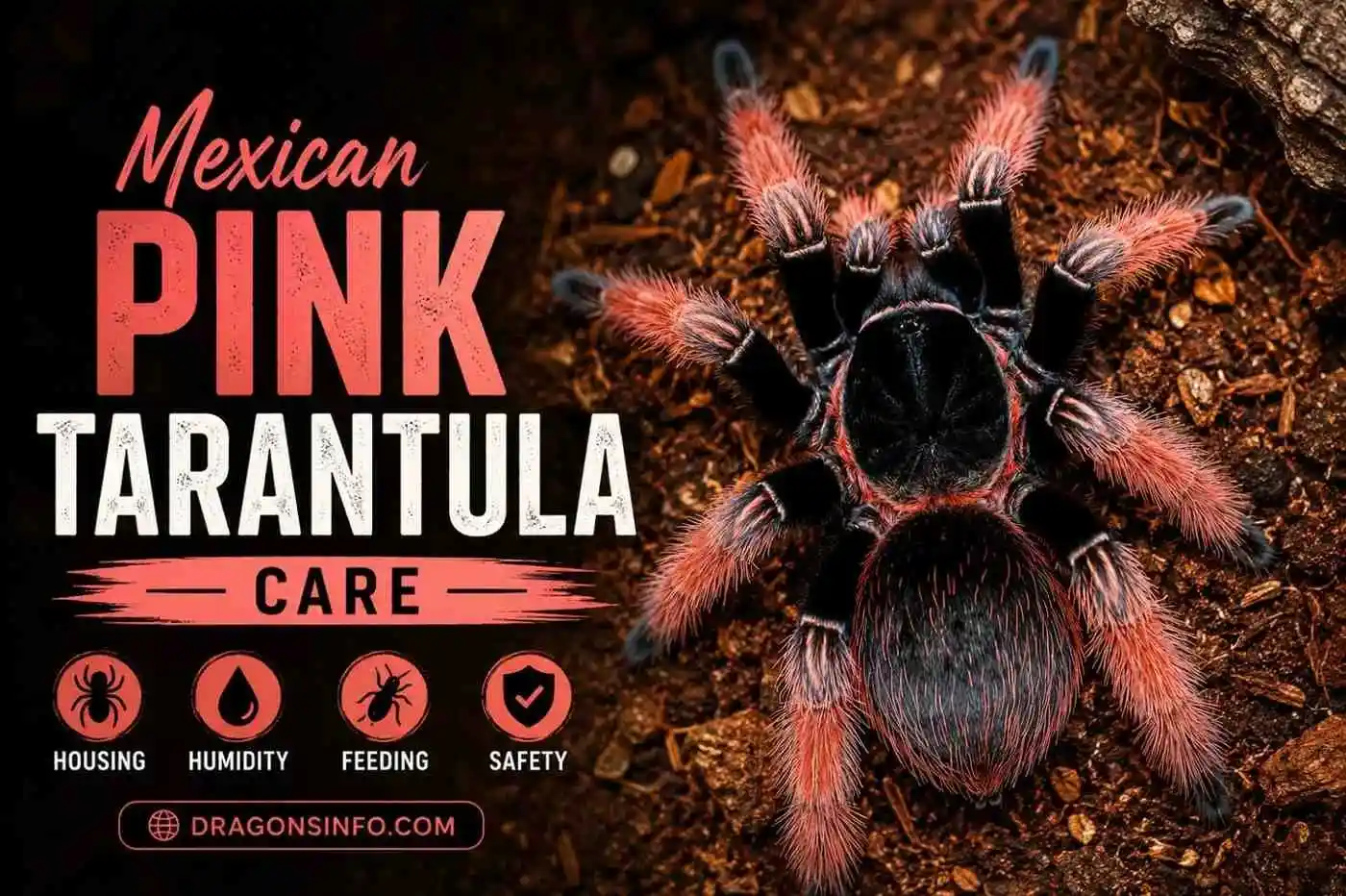
What Is Brachypelma klaasi?
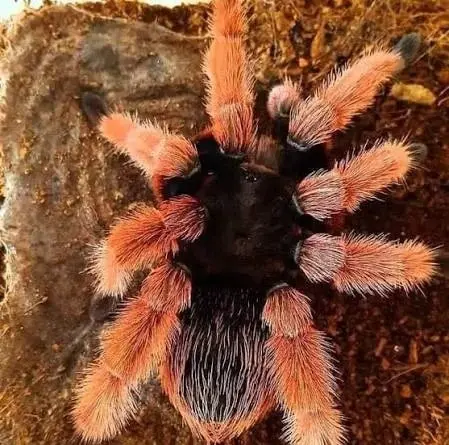
Brachypelma klaasi is a large, ground-dwelling tarantula native to the Pacific coast of Mexico. Keepers know it as the Mexican Pink Tarantula, Mexican Pink Beauty, or Mexican Pink-Leg. It stands out as the only member of the genus Brachypelma without red coloring; its leg hairs are a soft pink or rose, set against a deep velvet-black body.
The species was first described by Schmidt and Krause in 1994. It belongs to the family Theraphosidae and is one of the most sought-after tarantulas in the hobby thanks to its rarity, long lifespan, and beauty. Unlike its famous cousin the Mexican Red Knee (B. hamorii), B. klaasi is harder to find, slower to grow, and more expensive to buy.
This tarantula is a favorite “display species” because it often sits in the open as an adult rather than hiding in a burrow. That, combined with its rich pink tones, makes it a centerpiece tarantula for serious collectors.
Where the Name Comes From
The species name honors Peter Klaas, who first collected the tarantula in the wild. The genus name Brachypelma comes from Greek roots meaning roughly “short sole of the foot.” Knowing the origin is a small detail, but it is one most care sheets skip, and it helps confirm you are reading about the genuine article rather than a mislabeled look-alike.
Mexican Pink Tarantula Quick Facts
| Feature | Detail |
|---|---|
| Scientific name | Brachypelma klaasi (Schmidt & Krause, 1994) |
| Common names | Mexican Pink, Mexican Pink Beauty, Mexican Pink-Leg |
| Family | Theraphosidae |
| Native range | Jalisco and Nayarit, Mexico |
| Adult size | 5 to 6 inch (13–16 cm) leg span |
| Body length | 6 to 7.5 cm (2.4 to 3 in) |
| Female lifespan | 25 to 30+ years |
| Male lifespan | 5 to 6 years |
| Activity pattern | Diurnal (active by day) |
| Temperament | Docile but skittish |
| Venom risk to humans | Mild, similar to a bee sting |
| CITES status | Appendix II |
| Rarity | Rarest species in genus Brachypelma |
| Experience level | Beginner to intermediate (best as a second tarantula) |
| Price range | $150 to $400+ |
Appearance: How to Identify a Mexican Pink Tarantula
The Mexican Pink Tarantula has a jet-black body covered in short, velvety setae (hairs). Its most distinctive feature is the pink-to-rose coloring on the upper leg segments, the tibias, patellas, and metatarsals. The carapace is black, often with a subtle lighter pattern that becomes more visible as the spider matures.
Spiderlings look dull brown at first, with faint orange hints. The true pink coloring develops slowly, usually becoming visible once the spider reaches a 1 to 1.5-inch leg span and fully prominent at 2 inches or more. This slow color transformation is part of what makes raising a B. klaasi from a spiderling so rewarding.
Adult females are stockier with larger abdomens. Mature males are slimmer, have longer legs, show stronger color contrast, and develop tibial hooks on their front legs used during mating.
How Brachypelma klaasi Differs From Similar Species
Several tarantulas resemble B. klaasi, causing confusion in the pet trade. Here are the key differences:
| Species | Common Name | Main Difference From B. klaasi |
|---|---|---|
| B. klaasi | Mexican Pink | Black carapace, pink leg hairs |
| B. boehmei | Mexican Fire Leg | Yellow-orange carapace, orange leg hairs |
| B. baumgarteni | Mexican Orange Beauty | Slightly different leg band patterns and range |
| B. hamorii | Mexican Red Knee | Red-orange bands on knees, not pink hairs |
| B. emilia | Mexican Red Leg | Pink triangle on carapace, red legs |
B. klaasi is the only Brachypelma species without any red coloring. If a seller lists a “pink” Brachypelma, it is almost always B. klaasi.
Is the Mexican Pink Tarantula Dangerous?
No. The Mexican Pink Tarantula is not dangerous to humans. Its venom is mild, and its effects are similar to a bee sting. No fatalities have ever been reported. Bites are also extremely rare, since B. klaasi prefers to run away, hide in its burrow, or flick urticating’s hairs when threatened.
Urticating hairs are the main defense. When disturbed, the spider uses its back legs to flick tiny barbed hairs off its abdomen. These hairs can cause an itchy rash on human skin and serious irritation if they come into contact with the eyes. Always wash your hands after enclosure maintenance and avoid touching your face.
People with insect allergies should handle this species with extra care, as exposure to its hairs can trigger reactions.
Natural Habitat and Behavior
Mexican Pink Tarantula lives in the tropical deciduous forests of western Mexico at elevations between 300 and 1,400 meters. The soil is sandy, neutral, and low in organic matter. The climate is highly seasonal, hot and wet from roughly June to December and dry the rest of the year. The largest known wild population lives at the Chamela Biological Reserve in Jalisco.
In the wild, this species digs burrows 15 centimeters or more deep and up to around 60 centimeters in overall length. Each burrow has a horizontal entrance tunnel leading to a main resting chamber, plus a second, larger chamber where the spider consumes prey and molts. The entrance is lined with silk that acts as a tripwire; any vibration from passing prey signals the tarantula to strike.
A genuinely unusual trait: unlike most tarantulas, B. klaasi is diurnal. It is most active in the early morning and early evening rather than at night. Researchers link this to its bright coloring, and it is one of the few tarantulas you can reliably watch moving about during the day. The spider hunts both by “sit-and-wait” ambush and by actively searching the forest floor and nearby vegetation up to two meters high.
Natural predators include armadillos, skunks, snakes, and the tarantula hawk wasp (Pepsis spp.), which paralyzes the spider and uses it as a living nursery for its young.
How to Set Up a Mexican Pink Tarantula Enclosure
Enclosure Size
B. klaasi is terrestrial, so it needs more floor space than height. A good rule is that the enclosure floor should be at least 3 times the spider’s leg span in length and 2 times in width. The height should never exceed 1.5 times the leg span, because falls can rupture the abdomen and kill the spider.
- Spiderlings (under 1 inch): small acrylic container, around 3 × 2 × 2 inches
- Juveniles (1 to 2.5 inches): 6 × 6 × 6-inch enclosure
- Adults (3 inches and up): 10 to 12 inches wide, or a 5 to 10-gallon tank laid horizontally
Always use a secure lid with small ventilation holes. Tarantulas can climb glass and will escape through any gap.
Substrate
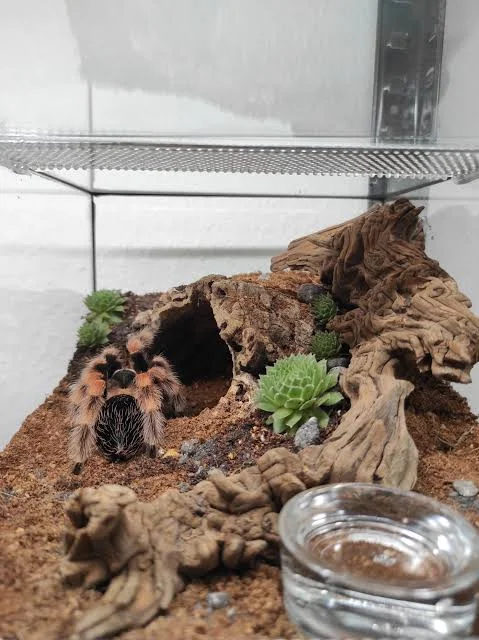
Use 4 to 6 inches of dry, chemical-free substrate. Good options include coco fiber, peat moss, organic topsoil, or a mix. Spiderlings especially love to burrow, so give them a deeper layer, at least twice their leg span in depth. Avoid sand, gravel, wood chips, or anything sharp that could injure the spider.
Hide and Decor
Provide a half-cork bark tube or clay flowerpot as a hide. Half-bury it so the spider can expand the burrow on its own terms. Add a few fake leaves or dried oak leaves for cover. Keep decor simple and avoid tall structures that could cause a fall.
Water Dish
Always keep a shallow water dish in the enclosure for adults over 2 inches. A small ceramic dish or reptile water dish works well. Refresh the water every few days and rinse the dish each time. Fresh water alone is enough; there is no need for cotton wool or moisture beads.
Temperature
Keep the enclosure between 70°F and 80°F (21°C to 27°C). Normal room temperature works in most homes. Avoid letting it drop below 65°F or climb above 85°F for long. A simple behavioral check helps: if the spider constantly presses against the warmest part of the enclosure it may want more heat, and if it hides in the coldest corner it may be too warm. Never place the enclosure in direct sunlight or near heating vents.
Humidity
Mexican Pink Tarantulas come from a scrubland and dry-forest climate, so keep things on the dry side. Aim for low to moderate humidity, roughly 60 to 70%, without ever keeping the enclosure wet.
The simplest reliable method is a full water dish plus a wet/dry cycle in one corner: lightly moisten one corner of the substrate, then leave it to dry out completely before repeating. Keep slings on lightly moist substrate. Do not mist the spider directly, and make sure ventilation lets the enclosure dry between moistenings.
Feeding Your Mexican Pink Tarantula
| Life Stage | Feeding Frequency | Prey Size |
|---|---|---|
| Spiderling (under 1 inch) | Every 5 to 7 days | Flightless fruit flies, pinhead crickets |
| Juvenile (1 to 3 inches) | Every 7 to 10 days | Small crickets, small dubia roaches |
| Adult (over 3 inches) | Every 7 to 14 days | 2 to 4 large crickets or 1 large roach |
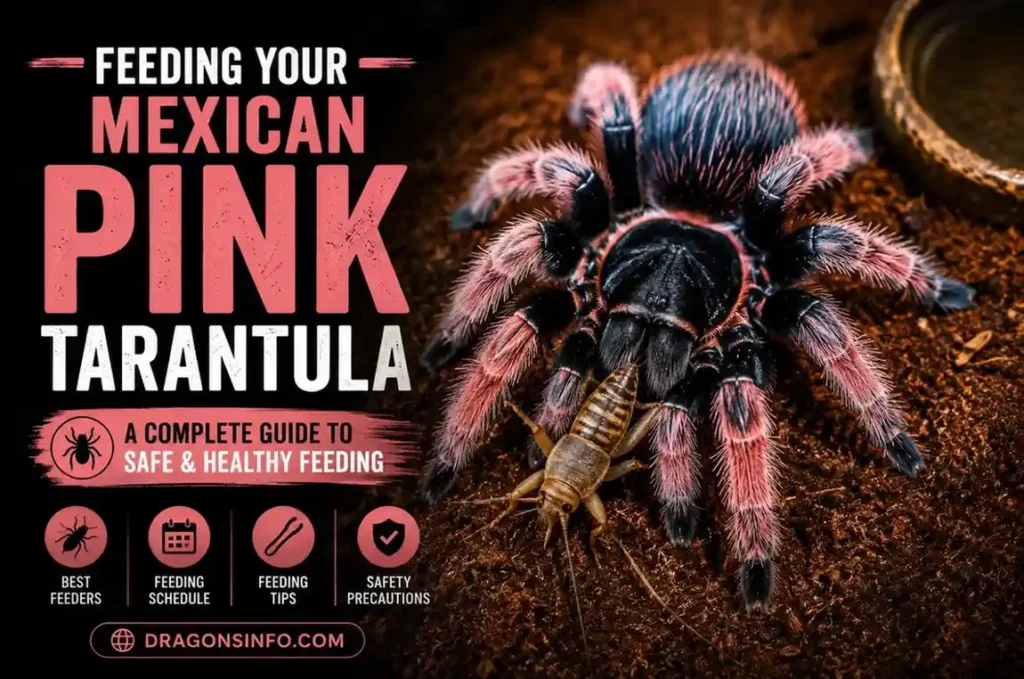
The best feeder insects are crickets, dubia roaches, mealworms, and the occasional waxworm as a treat. Prey should be no larger than the spider’s abdomen. Never feed wild-caught insects, as they may carry pesticides or parasites.
Expect fasting. Adults may refuse food for weeks, especially before a molt. As long as water is available and the abdomen stays plump (about the same width as the carapace), the spider is healthy.
Post-molt feeding: wait 4 to 7 days for juveniles and 7 to 14 days for adults before offering food. The fangs must fully harden (turn solid black) before the spider can eat safely.
A Note on Growth Rate
B. klaasi is a notably slow grower, so patience is part of the deal. As a rough real-world guide, a spiderling bought at around a quarter-inch may reach only about 1.5 inches after its first year, roughly 3 inches by year three, and full adult size of about 6 inches only after eight or more years. This slow pace is one reason adults command higher prices.
Handling: Should You Hold a Mexican Pink?
Most experienced keepers recommend not handling B. klaasi. Although this species is famously calm, it is also one of the more skittish Brachypelma, and a startled tarantula can dart suddenly, fall, or flick hairs.
The risks of handling include:
- Fatal falls. Even a few inches can rupture the abdomen.
- Hair flicking. It can cause painful skin and eye irritation.
- Stress. Tarantulas do not bond with people; handling only stresses them.
If you must move the spider, use a soft paintbrush or a deli cup to gently coax it. Never pick it up by hand.
How to Tell if Your Mexican Pink Is Male or Female
Because females live 25 to 30+ years while males live only 5 to 6, and because this is an expensive spider, sexing matters a great deal to buyers. Spiderlings and small juveniles cannot be reliably sexed; most can only be sexed accurately once they reach about a 2.5 to 3 inch leg span.
The most reliable method is molt sexing. On the underside of a shed molt, females show a flap-like fold (the spermatheca) between the top two pairs of book lungs, which will catch if you gently run a pin along it. Males show only a plain slit that does not open.
Mature males are also identifiable by their longer legs, stronger color contrast, and the small tibial hooks on their front legs. If lifespan matters to you, buy a confirmed female or a spider large enough to sex from a molt, and ask the seller directly. if you want to read more about another tarantulas then read this article
Molting: What to Expect
Molting is how tarantulas grow. B. klaasi molts frequently as a spiderling (every few weeks), less often as a juvenile, and only once a year or less as an adult female. Because this species grows slowly, molts are always a slow, careful process.
Signs of an upcoming molt:
- Loss of appetite lasting days or weeks
- Darkened, shiny, or bald abdomen
- Sealing off the burrow entrance
- Flipping onto the back (normal, do not touch the spider)
The molt itself takes several hours. During and after molting, the spider is soft and vulnerable, so do not disturb it. Wait at least a week before feeding an adult post-molt.
Common Health Problems and How to Avoid Them
Dehydration. The top cause of tarantula death in captivity. Always provide fresh water.
Fall injuries. Tall enclosures are dangerous. Keep height under 1.5 times the leg span.
Mites and fungus. Caused by uneaten food and overly damp substrate. Clean prey remains within 24 hours.
Dyskinetic Syndrome (DKS). A neurological disorder with twitching and loss of coordination. Suspected causes include pesticide exposure, chemical cleaners near the enclosure, or contaminated feeder insects. Keep the spider’s environment chemical-free.
Bald abdomen. Not a disease. The spider flicks urticating hairs when stressed. They grow back at the next molt.
Abdominal rupture. Usually from falls. Keep enclosures low and never startle the spider when it is climbing.
Breeding Brachypelma klaasi in Captivity
Breeding this species is slow and challenging. Females mature around 7 to 10 years old. Males mature at 4 to 5 years and live only about a year after maturity.
Introduce the male into the female’s enclosure at night or early morning, when both are most active. The male drums his legs on the substrate. If the female is receptive, mating occurs within minutes. Remove the male immediately afterward, as females can become aggressive post-mating.
A successful pairing results in an egg sac 4 to 6 months later, typically containing several hundred eggs (reports vary, from around 200 to as many as 800). Keep humidity slightly higher, around 65 to 75%, and temperature around 75°F during development. Spiderlings emerge after 8 to 10 weeks.
Because this is the rarest Brachypelma and a CITES-protected species, responsible captive breeding is vital to reducing pressure on wild populations. Breeding is not a project for beginners, since finding homes for hundreds of spiderlings is difficult.
How Much Does a Brachypelma klaasi Cost?
This is one of the more expensive Brachypelma because of its rarity and slow growth rate.
| Item | Approximate Cost (USD) |
|---|---|
| Spiderling (1/2 to 1 inch) | $80 to $150 |
| Juvenile (2 to 3 inches) | $150 to $250 |
| Adult female | $300 to $500+ |
| Mature male | $100 to $200 |
| Enclosure (adult) | $30 to $60 |
| Substrate, hide, water dish | $20 to $40 |
| First-year food | $50 to $80 |
| Total first-year cost | $250 to $600+ |
The ongoing yearly cost after setup is low, usually under $80 for food and occasional substrate changes.
Where to Buy a Brachypelma klaasi
Because this species is CITES-listed, always buy captive-bred specimens from reputable sources. Good options include:
- Specialty breeders with CITES documentation and positive reviews
- Trusted online dealers such as Josh’s Frogs, Jamie’s Tarantulas, and other established sellers
- Reptile and invertebrate expos, where you can inspect the spider in person
Avoid generic pet chains and any seller who cannot confirm captive-bred origin. Wild-caught specimens are illegal to import without proper permits and often arrive stressed and sick.
Conservation Status
Brachypelma klaasi is considered the rarest and most threatened species in the genus Brachypelma. It is protected under CITES Appendix II, which means international trade requires permits. Research shows that fewer than 0.1% of wild individuals survive from egg to adulthood, due to slow growth, habitat loss, and illegal collection.
Major threats include:
- Habitat destruction from agriculture and development in Jalisco and Nayarit
- Illegal collection for the pet trade despite CITES protection
- Climate shifts affecting spiderling survival, since temperature and humidity strongly influence their distribution
Responsible captive breeding and refusing to buy wild-caught specimens are the two most important actions keepers can take.
Beginner Mistakes to Avoid
- Using a tall enclosure. Tarantulas are ground-dwellers, and tall tanks cause fatal falls.
- Keeping the substrate too wet. Leads to mold, mites, and stress.
- Handling too often. Stressful for the spider and risky for you.
- Feeding too soon after a molt. Soft fangs tear easily. Wait for solid black fangs.
- Buying wild-caught specimens. Illegal and harmful to endangered populations.
- Using heat lamps or heat rocks inside the enclosure. They dehydrate and burn the spider.
- Cohabitating two tarantulas. B. klaasi is solitary. Housing two together leads to cannibalism.
Frequently Asked Questions
Is a Mexican Pink Tarantula good for beginners?
It can be, but it is better viewed as a beginner-to-intermediate species. It is docile and hardy, but more skittish, slower-growing, and more expensive than a Red Knee. A careful beginner with patience will do fine, though many keepers treat it as their second tarantula.
How long do Mexican Pink Tarantulas live?
Females live 25 to 30+ years. Males live only 5 to 6 years. Always ask the seller for the sex before buying.
How do you tell if a Mexican Pink Tarantula is male or female?
The most reliable method is molt sexing, which shows a spermatheca “flap” between the top two pairs of book lungs in females. Spiders can usually be sexed accurately once they reach about 2.5 to 3 inches.
Are Mexican Pink Tarantulas aggressive?
No, they are not aggressive. They are docile but skittish, more likely to hide or flick hairs than bite.
Are Mexican Pink Tarantulas venomous?
Yes, mildly. Their venom is weak and causes effects similar to a bee sting. They are not medically dangerous to healthy humans.
Do Mexican Pink Tarantulas burrow?
Yes, especially as spiderlings. Adults often prefer to use a pre-made hide rather than dig their own burrow, and they tend to sit out in the open.
How big do Mexican Pink Tarantulas get?
Adults reach a 5 to 6 inch (13 to 16 cm) leg span with a body length of 6 to 7.5 cm.
Are Mexican Pink Tarantulas rare?
Yes. B. klaasi is the rarest species in the Brachypelma genus, both in the wild and in the pet trade.
Are Mexican Pink Tarantulas nocturnal?
No. Unlike most tarantulas, B. klaasi is diurnal, with peak activity in early morning and early evening.
Can I keep two Mexican Pink Tarantulas together?
No. They are solitary and will cannibalize each other.
Why is my Mexican Pink Tarantula not eating?
The most common reason is an upcoming molt. Adults can fast for weeks or even months. As long as water is available and the abdomen is plump, the spider is healthy.
Is owning a Brachypelma klaasi legal?
Yes, as long as the spider is captive-bred and sold by a dealer with proper CITES documentation. Always keep records of purchases.
How often should I feed my Mexican Pink?
Spiderlings every 5 to 7 days, juveniles every 7 to 10 days, adults every 1 to 2 weeks. Skip feeding before and after molts.
Final Thoughts
The Mexican Pink Tarantula is a true crown jewel of the tarantula hobby. Its soft pink coloring, calm personality, long lifespan, and daytime activity make it one of the most rewarding species to keep. It demands a little more patience and budget than the more common Red Knee, but for many keepers, the payoff is a stunning display animal that can share their home for decades.
If you choose to bring one home, commit to captive-bred sourcing, a simple dry setup, fresh water, and minimal disturbance. You will be caring for one of the rarest tarantulas on Earth, and helping protect a species that needs responsible keepers more than ever.