Rose Hair Tarantula Care: The Complete Guide (Grammostola rosea & porteri)
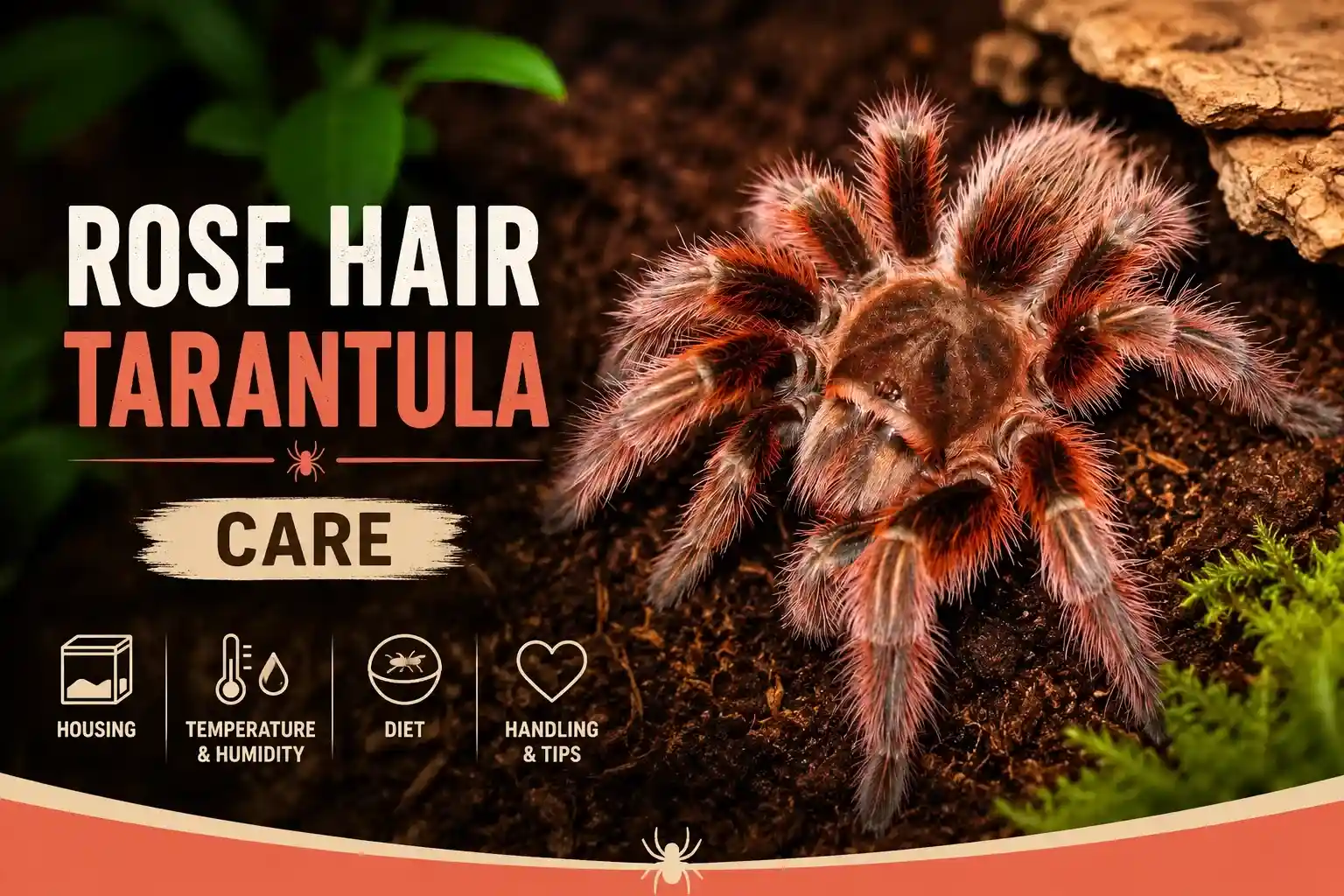
The rose hair tarantula is the spider most people meet first. It sits in the window of nearly every pet shop, it is cheap, it is hardy, and it is sold as the easiest tarantula you can own. Most of that is true. But the popular care guides for this species are also full of contradictions — especially about humidity — and they tend to oversell how “tame” it is.
This guide fixes that. You will get the correct care, the honest temperament, the truth about why your rose hair might refuse food for months, and a clear answer to the Grammostola rosea versus porteri confusion. Everything here is aimed at keeping the spider healthy, not at selling you one.
Rose Hair Tarantula at a Glance
| Attribute | Detail |
|---|---|
| Scientific names | Grammostola rosea (red form) and Grammostola porteri (grayish/normal form) |
| Common names | Rose hair, Chilean rose, Chilean rose hair, Chilean fire tarantula, “Rosie” |
| Adult leg span | About 4.5–5.5 inches (11–14 cm) |
| Lifespan | Females 15–20+ years; males roughly 3–5 years |
| Native range | Arid scrubland and grassland of Chile, Bolivia and Argentina |
| Type | New World, terrestrial (ground-dwelling) |
| Temperament | Usually docile, but genuinely unpredictable |
| Difficulty | Beginner |
| Enclosure | 5–10 gallon footprint; wider than tall |
| Temperature | Normal room temperature, about 70–80°F (21–27°C) |
| Humidity | Low — dry substrate plus a water dish. No routine misting needed |
| Diet | Live insects (crickets, dubia roaches, locusts) |
| Handling | Tolerated by many, but best kept to a minimum |
Is the rose hair tarantula right for you?
It is an excellent first tarantula if you want a long-lived, low-effort, low-cost pet you mostly observe rather than interact with. It is a poor choice if you want a spider that is always visible and always eating, or one you can reliably handle — this species hides, fasts for long stretches, and has real mood swings. If “a fascinating pet rock that occasionally surprises you” sounds appealing, it is perfect.
What Is a Rose Hair Tarantula?
The rose hair is a medium-sized, ground-dwelling spider native to the dry regions of Chile, Bolivia and Argentina. Its body is a dusky brown or grey overlaid with a pinkish or reddish sheen across the carapace and legs — that rosy gleam is where the name comes from. The redder individuals are sometimes sold as “Chilean fire” tarantulas.
In the wild it is a nocturnal ambush hunter that shelters in burrows and crevices during the day and comes out at night to take passing insects. Understanding that arid, burrow-dwelling origin is the key to keeping it correctly: this is a desert-edge animal, not a rainforest one.
Grammostola rosea vs. Grammostola porteri: What’s the Difference?
This is the single most confusing thing about the species, so here is the honest version.
When the Chilean rose first entered the pet trade, it was all sold as Grammostola rosea and came in two color forms: a red color form (RCF) and a normal, grayish normal color form (NCF). As the taxonomy was studied more closely, the two forms were split: the red form kept the name Grammostola rosea, while the grayish normal form was reclassified as Grammostola porteri.
| Feature | G. rosea (Red Color Form) | G. porteri (Normal Color Form) |
|---|---|---|
| Typical color | Warmer, reddish/copper hues | Cooler grey-brown with a pink wash |
| Old trade name | Sold as G. rosea RCF | Sold as G. rosea NCF |
| Current status | Grammostola rosea | Grammostola porteri |
| Availability | Less common, often pricier | The “default” pet-shop rose hair |
| Care needs | Identical | Identical |
The practical takeaway: for husbandry it does not matter which one you have. Their care is the same. The names matter only for buying accurately and for talking to other keepers.
Why the taxonomy is still debated
Be aware that this split is not universally settled. The World Spider Catalog lists the two as separate species, but experienced keepers still argue about how cleanly the color forms map onto them, and some believe trade naming muddied the picture over the years. If a seller insists they can guarantee one over the other from a juvenile spider alone, treat that with mild skepticism — color deepens with age, and certainty usually comes from the adult animal.
Are Rose Hair Tarantulas Good for Beginners?
Yes — with two honest caveats.
The case for them: They are hardy and forgiving of small mistakes in temperature and humidity. They are inexpensive and widely available. They need very little space and very little day-to-day attention. And they live a long time, so a single spider can be a 15- to 20-year companion.
What beginners aren’t told: First, they are very slow growers, so if you want to watch a spider visibly grow, this is not your species. Second, they are famous for refusing food for months at a time, which panics new keepers who think the spider is dying. Both are normal. If you go in expecting a patient, undemanding animal rather than an active one, you will love it.
Rose Hair Tarantula Enclosure Setup
Tank size and type
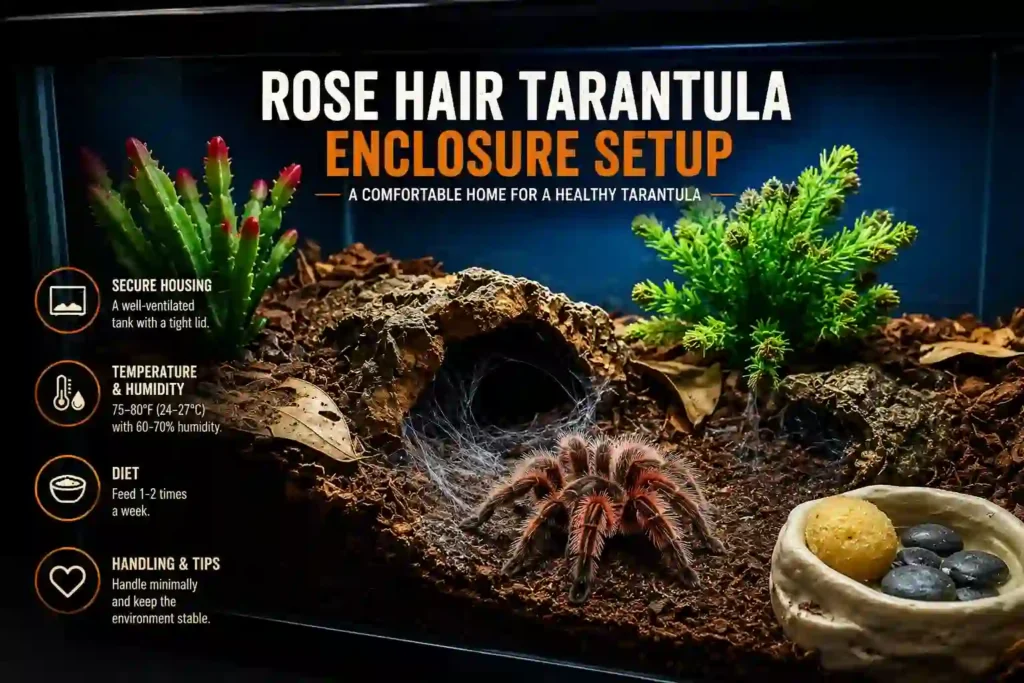
An adult rose hair tarantula needs surprisingly little room. A 5- to 10-gallon enclosure is plenty. The important rule is floor space over height: this is a terrestrial spider, and a tall tank is both pointless and dangerous, because a fall from height can rupture the abdomen. Choose an enclosure that is wider than it is tall, with cross-ventilation and, ideally, a front-opening door so you can do maintenance without looming over the spider.
Slings (babies) should start in small containers — a deli cup with pin-prick air holes — and move up in size as they grow. A sling lost in a huge enclosure struggles to find food.
Best substrate and how deep
Use a dry, chemical-free substrate that holds its shape: coconut fiber (coco coir), peat moss, or a plain organic, pesticide-free topsoil all work. Give an adult two to four inches of depth so it can scrape out a shallow scrape or burrow if it wants to. Avoid sand, gravel, and any aromatic or treated wood.
Hides and decoration
Provide one secure hide — a piece of cork bark, a half log, or a cork tube — placed on the substrate. The spider needs somewhere to feel covered. You can add a fake plant or two for cover, but keep the layout simple and make sure nothing heavy can topple onto the animal.
Do rose hairs need a lid? (Escape-proofing)
Absolutely. A secure, ventilated lid is non-negotiable. Rose hairs can and do climb the glass, especially when restless, and an escaped tarantula in a home rarely ends well for the spider. Make sure the lid latches and that any gaps are smaller than the spider’s body.
Temperature and Lighting
Ideal temperature range
Aim for normal room temperature, roughly 70–80°F (21–27°C). The simplest rule in the hobby applies here: if you are comfortable in the room, your tarantula is comfortable too. A few degrees cooler at night is fine and natural.
Do rose hair tarantulas need heating?
Usually not. If your home stays in the comfortable range year-round, no heat source is needed. If the room genuinely drops cold in winter, use a low-wattage heat mat stuck to the side of the enclosure (never underneath, never inside), controlled by a thermostat. Never use a heat lamp or hot bulb — these cook and dehydrate the spider and have killed many.
Do they need special lighting? (Myth-bust)
No. This is worth stating plainly because some older guides still recommend giving the spider a set number of hours of light per day — that advice is wrong. Tarantulas are nocturnal, need no UVB, and actively avoid bright light. Ambient room light on a normal day-night cycle is all they require. Direct sun on the enclosure is dangerous and can overheat it quickly.
Humidity and Misting: What Rose Hairs Actually Need
Here is the correction that matters most in this entire guide: rose hairs do not need high humidity, and they do not need regular misting. They come from an arid environment. A bowl of fresh water and mostly dry substrate is all the moisture a healthy adult needs.
Why rose hairs don’t need high humidity
Because the species is from dry Chilean scrubland, chasing high humidity numbers works against its biology. Many popular care sheets quote figures anywhere from 55% to 70% and tell beginners to mist the enclosure to hit them. Following that advice often leads to a chronically damp tank, which causes mold, stuffy air, and stress — and damp, stagnant conditions are far more dangerous to this species than dry ones.
The water dish method vs. misting
Keep a shallow water dish topped up with clean water at all times — that is your humidity source and your drinking source in one. Skip the hygrometer-chasing and skip the misting. If you ever want a small, brief moisture bump (for example, a sling you are worried about), overflowing the water dish onto one corner of the substrate is gentler and safer than spraying the whole tank.
Common humidity mistakes that harm your tarantula
The three big ones: sealing off ventilation to “hold humidity,” misting daily, and keeping the substrate constantly wet. All three create the damp, airless conditions this arid spider is least equipped to handle. When in doubt, keep it drier and make sure there is always water in the dish.
Feeding Your Rose Hair Tarantula
What do rose hair tarantulas eat?
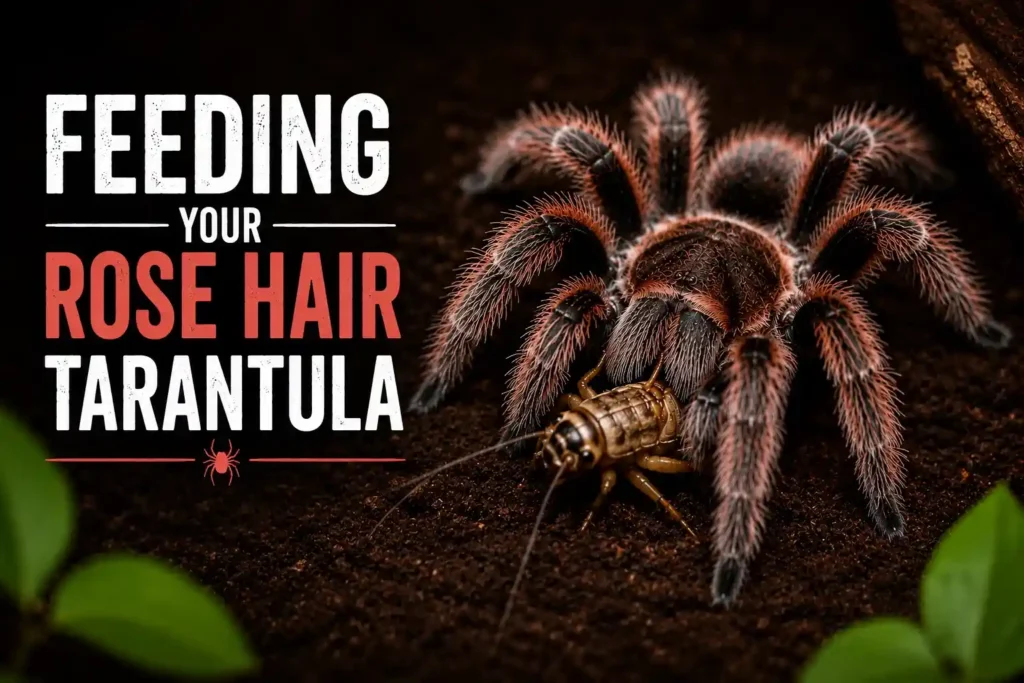
Live insects. Crickets, dubia roaches, and locusts are staples; mealworms and the occasional waxworm work as variety. Gut-load the feeders — feed them nutritious vegetables for a day or two before offering them — so your tarantula gets the nutrition second-hand. Prey should be no larger than the spider’s body length.
How often to feed (slings vs. adults)
Younger spiders eat more often; adults eat slowly and infrequently. Use this as a starting point, then let the spider’s appetite guide you.
| Life stage | Prey size | Feeding frequency | Notes |
|---|---|---|---|
| Sling | Pre-killed or tiny prey | Every 4–7 days | Remove uneaten food within 24 hours |
| Juvenile | 1–2 appropriately sized insects | Once a week | Watch for pre-molt fasting |
| Adult | 2–4 insects, or 1 large roach | Every 1–2 weeks | Long fasts are normal — see below |
Always remove uneaten prey within about 24 hours. A loose cricket left in the enclosure can stress or even injure a tarantula, especially during a molt.
Water and hydration
A shallow water dish with clean water, refilled regularly, is essential — far more important than any humidity number. Keep the dish shallow so the spider cannot drown, and rinse it when it gets soiled.
Why Is My Rose Hair Tarantula Not Eating?
Short answer: this is almost always normal. The rose hair tarantula is one of the most notorious fasters in the entire hobby. Healthy adults routinely refuse food for months, and fasts of a year or more are well documented by experienced keepers. As long as the spider is otherwise healthy, a hunger strike is not an emergency.
How long can a rose hair go without food?
A long time. Adults can comfortably go 6 to 18 months between meals, and some keepers report even longer with no ill effect. These spiders evolved in a feast-or-famine environment and are built to ride out long gaps. A plump abdomen and access to water mean a fasting rose hair is in no immediate danger.
Normal fasting vs. a real problem
The decision tool below helps you tell a normal hunger strike from something to watch.
| Sign | Normal (don’t worry) | Possible problem (watch closely) |
|---|---|---|
| Duration | Weeks to many months | Fasting plus visible decline |
| Abdomen | Plump and rounded | Severely shriveled or shrunken |
| Posture | Normal, or tucked in a hide | Curled “death curl” with legs under body |
| Activity | Calm, occasionally roaming | Lethargic with other symptoms |
| Pre-molt clues | Darkening abdomen, sealing burrow, webbing | — |
If the only “symptom” is that the spider won’t eat, relax and keep water available. If refusal comes with a rapidly shrinking abdomen or a curled, collapsed posture, that points to dehydration or illness rather than a simple fast — make sure there is water and seek experienced advice.
Is it about to molt?
Often, yes. Tarantulas usually stop eating before a molt. A darkening or balding patch on the abdomen, a sealed-off burrow, fresh webbing, and general lethargy are classic pre-molt signs. Once you spot them, stop offering food entirely and wait.
Temperament and Behavior: The Truth About “Docile”
Are rose hair tarantulas aggressive?
Most of the time, no — but the “calm pet rock” reputation oversells them. Rose hairs are generally slow and docile, yet the hobby is full of “Psycho Rosie” stories: individuals that sit motionless for weeks, then suddenly bolt, flick hairs, rear up, or strike with no obvious trigger. Temperament varies a lot from one spider to the next. Treat every rose hair as an animal that can have an off day, and you will never be caught out.
Understanding “Psycho Rosie” mood swings
A spider that was placid for months can turn skittish or defensive overnight, then settle again. This unpredictability is normal for the species and is not a sign you have done anything wrong. The practical response is simply to read the spider before every interaction and never assume yesterday’s mood is today’s.
Threat postures and warning signs
Rose hairs usually warn before they bite. Learn to read them.
| Behavior | What it means | What you should do |
|---|---|---|
| Raised front legs / exposed fangs | Classic threat posture — “back off” | Stop, close the enclosure, give it space |
| Flicking hairs off the abdomen | Defensive; throwing urticating hairs | Step back; avoid face/eyes |
| Bald patch on abdomen | Hairs have been kicked off (or pre-molt) | Normal; expect a molt before regrowth |
| Sealing the burrow / heavy webbing | Often pre-molt | Stop feeding; do not disturb |
| Sitting in the water dish | Sometimes thirst or dryness | Check the water dish is full |
| Sudden charging at movement | Strong feeding or defensive response | Keep fingers out; use tongs |
Urticating hairs (Type III) and what they do
Like most New World tarantulas, rose hairs carry urticating hairs on the abdomen and can kick them at a threat. These barbed hairs cause itching and irritation on skin and are genuinely nasty if they reach your eyes or airways. They are a defense, not venom, but they are the main reason to wash your hands after any enclosure work and to keep your face away from a stressed spider.
Handling a Rose Hair Tarantula
Should you handle your tarantula?
Honestly: keep it to a minimum, or not at all. Many rose hairs tolerate gentle handling, but there is no real benefit to the spider and several real risks. Tarantulas do not bond with people, handling stresses them, and — most importantly — a fall of even a few inches can fatally rupture the abdomen. The safest relationship with a rose hair is observation, not interaction.
How to handle safely (if you must)
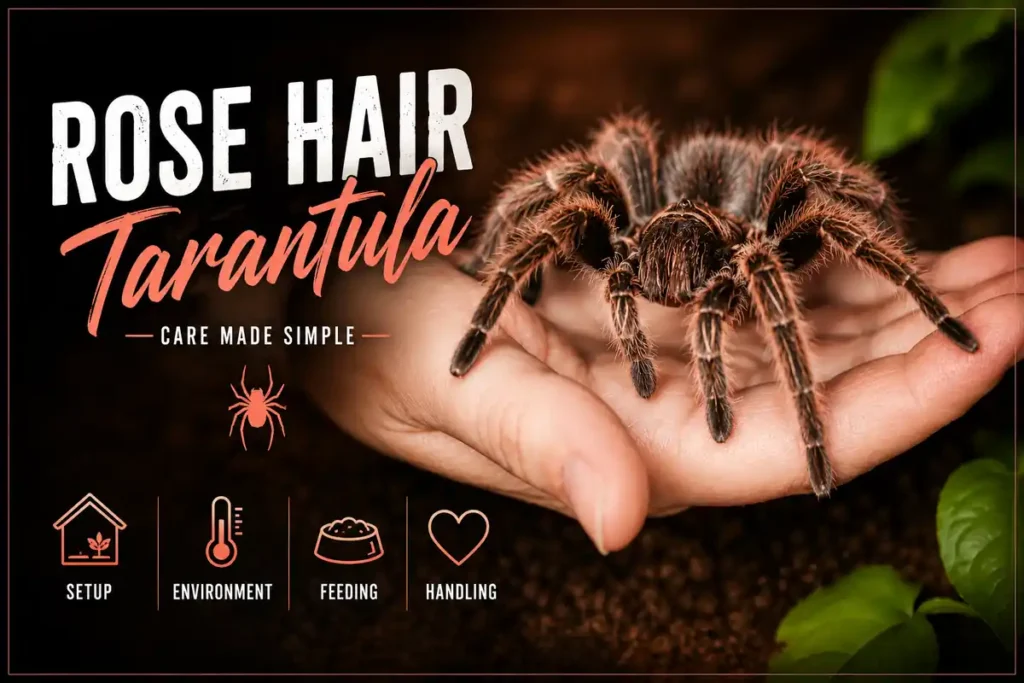
If you genuinely need to move the spider, do it low and slow. Work just above a soft surface like a bed so any fall is short. Coax the spider gently onto your open hand rather than grabbing from above, keep movements calm, and never blow on it or make sudden motions. Skip handling entirely around a molt, when the new exoskeleton is soft and easily damaged.
First aid for urticating hairs and bites
For urticating hairs on skin, do not rub — rinse with water and use tape to lift hairs off if needed; an antihistamine cream can ease itching. If hairs reach your eyes, flush with water and see a doctor, as eye exposure can be serious. A rose hair bite is comparable to a bee sting for most people — painful, with local itching and swelling, but not medically dangerous — unless you have an allergy. If a bite causes anything beyond local pain, or you have a known allergy, seek medical advice.
Molting
How often rose hairs molt (a slow grower)
Young rose hairs molt several times a year; adults typically molt about once a year, sometimes less. This is a slow-growing species, so do not expect dramatic size changes between molts. Each molt is also when the spider regrows any lost limbs and replaces worn parts.
Signs your rose hair is about to molt
Watch for a loss of appetite, a darkening or balding patch on the abdomen, lethargy, fresh webbing, and the spider sealing itself away. Many rose hairs flip onto their backs to molt — which alarms new keepers, but it is completely normal.
What to do (and never do) during a molt
When a tarantula is molting, leave it completely alone. Do not touch it, do not feed it, and do not “help.” Remove any live prey from the enclosure immediately, since a cricket can injure a soft, defenseless molting spider. After the molt, wait until the new exoskeleton has hardened — usually about a week for an adult — before offering food again. Feeding too early, while the fangs are still soft, can hurt the spider.
Lifespan and Sexing
How long do rose hair tarantulas live?
Females are remarkably long-lived, commonly reaching 15 to 20 years and sometimes beyond. Males live far shorter lives, generally around 3 to 5 years. This is one of the longest-lived spiders you can keep, so buying one is a genuine long-term commitment.
Why females outlive males
Once a male reaches maturity — marked by a final “ultimate” molt — his life is essentially built around finding a mate, and he typically dies within a year or two afterward. Females keep molting and living for many more years. This is why the spider’s sex matters so much to buyers.
How to tell if your rose hair is male or female
The reliable methods come with maturity and molting. Mature males develop small hooks on the underside of the front legs (tibial hooks) and modified pedipalps used in mating; they are also leggier and smaller-bodied. The most dependable method is examining a shed molt for the female’s internal sperm-storage structure (the spermathecae). Guessing from a young spider’s appearance alone is unreliable — if lifespan matters to you, buy a confirmed female or a spider old enough to sex from a molt.
Health Problems and Warning Signs
Dehydration
The most common avoidable problem, and almost always caused by an empty water dish — not by low humidity. Signs include a shrunken abdomen and lethargy. The fix is simple: always keep clean water available. This is far more important than any misting routine.
Falls and abdominal injuries
The abdomen is fragile and a fall can rupture it, which is frequently fatal. This is why low enclosures and careful (or no) handling matter so much. If you ever see fluid leaking from the abdomen after a fall, a keeper may stem minor bleeding with cornstarch or a dab of petroleum jelly, but prevention is the real answer.
When to be concerned
A healthy fasting rose hair sits calmly with a normal body. Be concerned when fasting comes with a severely shriveled abdomen, lethargy combined with other symptoms, or a curled “death curl” with the legs drawn under the body — that posture signals serious distress, often dehydration. When something looks genuinely wrong, get water into the enclosure and seek advice from an experienced keeper or an exotics vet.
Buying a Rose Hair Tarantula
Captive-bred vs. wild-caught (the ethical sourcing issue)
This species is still collected from the wild and imported in large numbers, so where your spider comes from genuinely matters.
| Factor | Captive-bred | Wild-caught |
|---|---|---|
| Parasites/health | Generally cleaner and healthier | Higher risk of mites and parasites |
| Conservation | No pressure on wild populations | Pressure on wild populations |
| Temperament | Often calmer, used to captivity | Can be more stressed and defensive |
| Price | Sometimes slightly higher | Often cheaper |
| Recommendation | Preferred | Avoid where possible |
Buying captive-bred supports ethical breeders and usually gets you a healthier, better-adjusted spider.
What to look for in a healthy tarantula
Choose an alert spider with a rounded (not shriveled) abdomen, all eight legs, and no fluid or stuck shed on the body. A spider that responds to gentle disturbance is a good sign; a sluggish one with a shrunken abdomen sitting in the open may be dehydrated or unwell.
Are rose hair tarantulas legal where you live?
Laws vary widely around the world. In much of the United States and Europe, rose hairs are legal and easy to buy, but some regions and countries restrict or ban keeping exotic invertebrates, and import rules differ from place to place. Before buying, check your national and local regulations — and if you ever plan to move or travel with the animal, check transport rules too. A few minutes of research now avoids a serious problem later.
Frequently Asked Questions
Do rose hair tarantula bites hurt?
A bite feels roughly like a bee sting for most people — local pain, itching, and swelling — and is not medically dangerous unless you are allergic. Bites are also rare; the spider usually warns or flees first.
Why is my rose hair tarantula on its back?
It is almost certainly molting, which is completely normal. Leave it strictly alone, remove any live prey, and do not feed it until the new exoskeleton has hardened about a week later. A spider curled with its legs under its body, right-side up, is a different and worrying sign.
How much does a rose hair tarantula cost?
They are among the cheapest tarantulas in the hobby, typically inexpensive as juveniles, with confirmed adult females and the redder G. rosea form costing a little more. Prices vary by region and seller.
Can rose hair tarantulas be kept together?
No. They are solitary and cannibalistic — housing two together usually ends with the larger eating the smaller. Always keep one spider per enclosure.
Why is my rose hair tarantula not moving?
Long periods of stillness are normal for this slow, sedentary species, and it may also be in pre-molt. As long as the abdomen looks healthy and water is available, stillness alone is not a concern.
Do rose hair tarantulas need a heat lamp?
No. They do well at normal room temperature and a heat lamp can overheat and dehydrate them. If your room is genuinely cold, use a thermostat-controlled heat mat on the side of the enclosure instead.
Final Thoughts
The rose hair earns its reputation as a starter species — it is hardy, cheap, long-lived, and undemanding. The trick is keeping it on its terms rather than the terms of an oversimplified care sheet: keep it dry with constant access to water, at comfortable room temperature, in a low enclosure, and leave it alone far more than you interact with it. Expect long fasts, expect the occasional bad mood, and expect a slow, quiet, fascinating animal that may well outlive a decade of other pets. Go in with those expectations, and a rose hair is one of the most rewarding first tarantulas you can choose.