Curly Hair Tarantula Care: The Complete Detailed Guide (2026)
If you’re reading this, someone probably told you to get a Curly Hair Tarantula as your first spider. Honestly, they gave you solid advice. The Tliltocatl albopilosus — formerly Brachypelma albopilosum — is a rare pet that looks incredible, requires minimal daily effort, and forgives beginner mistakes. Here’s what nobody mentions: there’s a big difference between keeping a Curly Hair alive and keeping one thriving. I’ve seen many new keepers lose their first tarantula to preventable problems — overfeeding, stuck molts, enclosures that were too tall, and humidity that was too high. This guide covers everything the basic care sheets leave out. Whether you’re still deciding if this species is right for you or you’ve already got a sling in a deli cup, you’ll find what you need here.
Quick Species Snapshot
| Attribute | Detail |
|---|---|
| Scientific name | Tliltocatl albopilosus (formerly Brachypelma albopilosum) |
| Common names | Curly Hair Tarantula, Honduran Curly Hair, Nicaraguan Curly Hair |
| Category | New World, terrestrial, semi-burrowing |
| Native range | Costa Rica (type locality); Honduran and Nicaraguan “forms” are also widespread in the hobby |
| Adult body length | ~3 inches (8 cm) |
| Diagonal leg span | ~5.5–6.5 inches (14–17 cm) |
| Urticating hairs | Yes — Types I and III |
| Growth rate | Medium (moderate — often faster than a Rose Hair or Red Knee) |
| Lifespan | Females up to 25 years; males ~4–5 years |
| Experience level | Beginner |
| CITES status | Listed (virtually all specimens in the trade are captive-bred) |
What Makes the Curly Hair Tarantula So Popular?
Think of the Curly Hair as the golden retriever of the tarantula world. It’s calm, forgiving, widely available, and has a personality — or rather, a lack of aggression — that makes even arachnophobes do a double-take.
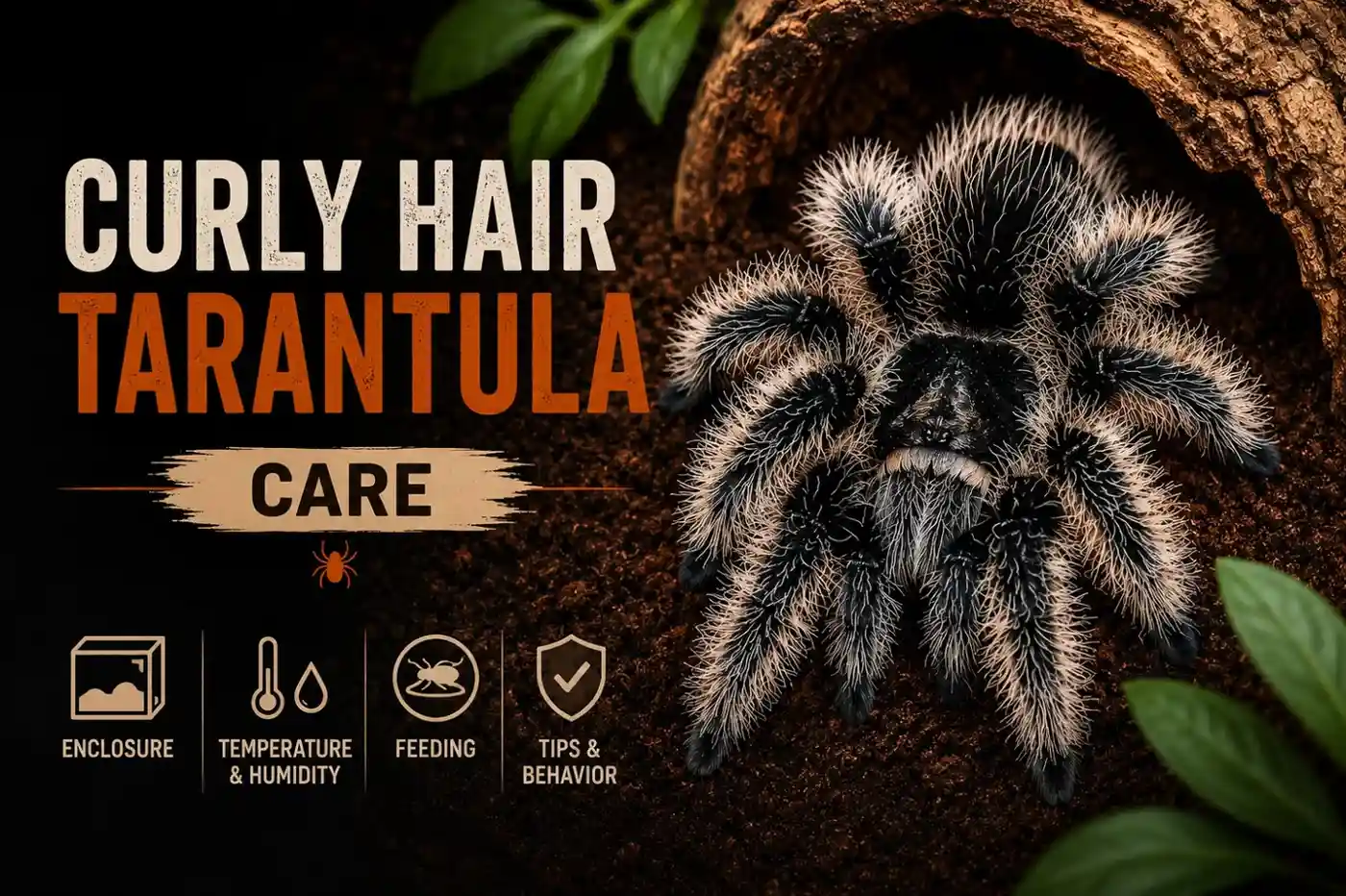
The species gets its name from the long, wiry, curled setae covering its body and legs. These serve a sensory purpose and give the spider a fluffy, teddy-bear-like appearance that has made it a social media favorite and a staple at reptile expos for decades.
T. albopilosus has been in the pet trade since the 1980s, when wild-caught specimens were imported heavily from Central America. That demand eventually led to the species being placed on the CITES list — the Convention on International Trade in Endangered Species — which regulates cross-border wildlife trade. The good news? Today, nearly every Curly Hair you’ll find for sale is captive-bred, which means buying one is both ethical and easy.
What keeps this species at the top of every “best beginner tarantula” list is its hardiness, low maintenance, and visibility. Unlike species that vanish into burrows for months, adult Curly Hairs sit out in the open, giving you something to look at. They move slowly, rarely throw a threat pose, and are as forgiving as a tarantula gets when humidity or feeding isn’t perfect.
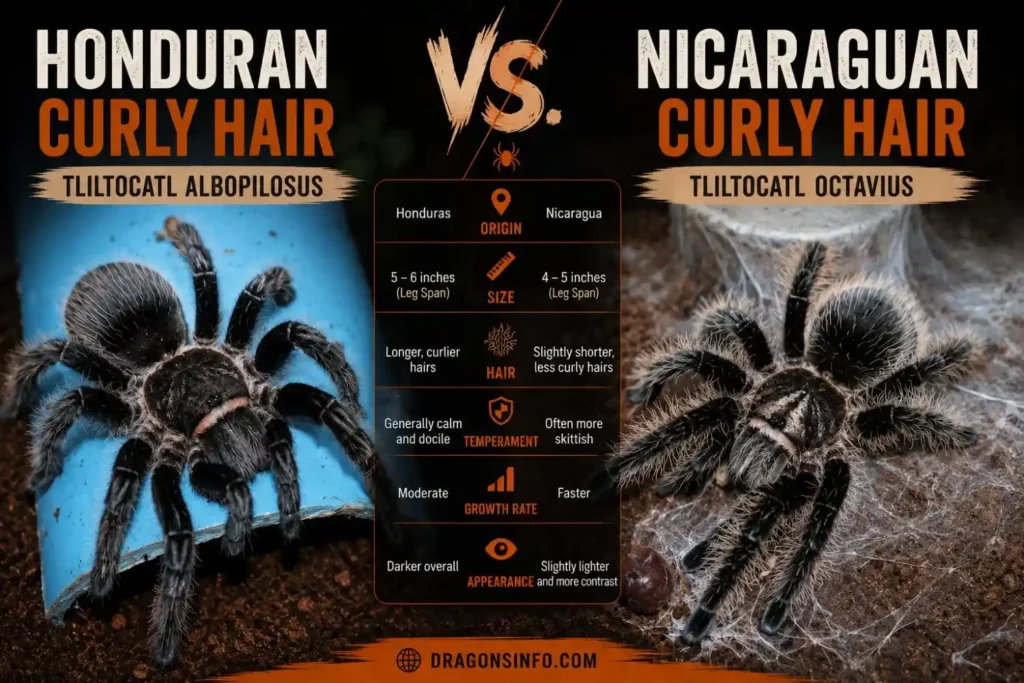
Honduran vs. Nicaraguan Curly Hair
If you’ve spent any time in tarantula forums, you’ve probably seen debates about “Honduran” vs. “Nicaraguan” Curly Hairs. Here’s what you need to know as a buyer.
The hobby has recognized two forms of T. albopilosus for years. The Honduran form — the one most common in pet stores — has more golden-brown setae and is believed to have been crossbred with related species over decades of casual breeding. The Nicaraguan form typically has whiter or lighter setae against a darker body and is considered by many breeders the “true” or thoroughbred form, matching the original type specimen described in 1980.
Definitive DNA research is still ongoing. Nobody can tell you with absolute certainty which form you have unless you have documented lineage from a reputable breeder.
What this means for you as a buyer: If lineage matters to you, purchase from a breeder who can document their breeding stock. Ask where their original specimens came from. If you’re buying from a pet store, you’re almost certainly getting a Honduran-form or mixed-lineage specimen — and that’s perfectly fine. Both forms require identical care, have the same temperament, and will give you the same rewarding keeping experience. Don’t overpay for a “Nicaraguan” label unless the seller can back it up with real breeding records.
Before You Buy — What No One Tells First-Time Owners
Getting a Brachypelma albopilosum Tarantula is easy. Keeping one well requires planning. Here’s what the pet store employee probably won’t mention.
Realistic Cost Breakdown
The spider itself is one of the cheapest parts of this hobby. A spiderling typically runs $15–$30, while a juvenile or sub-adult might cost $30–$60. Adult females — because of their dramatically longer lifespan — can command $50–$80 or more, depending on size and confirmed lineage.
Your initial enclosure setup will cost $50–$120, depending on whether you choose a basic acrylic container or a glass terrarium with front-opening doors. Substrate, a cork bark hide, a water dish, and a thermometer/hygrometer combo complete the setup. Monthly ongoing costs are minimal — roughly $5–$15 for feeder insects. No special lighting, expensive supplements, or vet visits are usually needed.
The Lifespan Commitment
This is the part that catches people off guard. A female Curly Hair can live 20–25 years in captivity. That’s not a pet you pick up on impulse — that’s a commitment that could outlast your car, your apartment lease, and possibly your marriage. Males live around 4–5 years, so if you want a shorter commitment, a confirmed male is a reasonable choice.
Finding an Exotic Vet Before You Need One
Most regular veterinarians won’t know what to do with a tarantula. Before you bring your spider home, search for an exotic animal veterinarian in your area. The Association of Reptilian and Amphibian Veterinarians (ARAV) is a good starting point. Having a vet identified before an emergency happens can literally save your tarantula’s life — especially in situations like a stuck molt or suspected parasites.
Red Flags When Buying
Avoid sellers who can’t tell you whether a specimen is captive-bred. Wild-caught adults are not only ethically problematic — they often come with parasites and tend to be more stressed and defensive. Be cautious of abnormally low prices from unknown online sellers. Buy from established breeders, reputable dealers at reptile expos, or well-reviewed online tarantula shops.
Curly Hair Tarantula vs. Other Beginner Species
If you’re still deciding on your first tarantula, here’s how the Curly Hair compares to the species you’ll see recommended most often.
| Species | Leg Span | Female Lifespan | Temperament | Type | Growth | Price | Best For |
|---|---|---|---|---|---|---|---|
| Curly Hair (T. albopilosus) | ~6 in | Up to 25 yrs | Docile | Terrestrial burrower | Medium | $20–$60 | Absolute beginners — hardy and visible |
| Mexican Red Knee (B. hamorii) | ~6 in | Up to 25 yrs | Docile | Terrestrial | Slow | $50–$100+ | Most striking looks; can be a hair-kicker |
| Rose Hair (Grammostola sp.) | ~5.5 in | Up to 20 yrs | Variable / moody | Terrestrial | Very slow | $20–$50 | Cheap, but known for long fasting |
| Pink Toe (Caribena versicolor) | ~5.5 in | ~12 yrs | Docile | Arboreal | Medium | $30–$70 | Gorgeous, but needs vertical setup + more humidity |
The Curly Hair wins for most first-time keepers because it combines the easiest care requirements with high visibility and rock-solid temperament. If you want something flashier and don’t mind spending more, the Mexican Red Knee is the main alternative.
Setting Up the Perfect Enclosure
Getting the enclosure right from the start prevents the vast majority of health issues. The setup changes as your tarantula grows.
Spiderlings (Slings)
A small acrylic container works perfectly — think deli cups, small acrylic cubes, or purpose-built sling enclosures. The enclosure should be no smaller than three times the spider’s leg span in both length and width.
Fill at least two-thirds of the container with substrate. Coconut fiber (eco earth), a mix of organic topsoil and peat moss, or a purpose-made tarantula substrate all work well. The key is depth — slings are burrowers, and they need enough material to dig into.
Keep the substrate slightly damp but never swampy. A small water drop on one corner of the substrate once a week is usually sufficient. Make sure there are a few tiny ventilation holes in the lid and sides — slings need airflow, but the holes should be small enough that the spider can’t escape through them. For very small slings, a bottle cap or a damp patch of substrate serves as a water source in place of a dish.
Juveniles
Once your Tliltocatl albopilosus tarantula outgrows its sling enclosure, move it to a medium-sized container — roughly 3–4 times the leg span. Fill the enclosure about halfway with substrate to provide burrowing depth while keeping the distance between the substrate surface and the lid short enough to prevent dangerous falls.
Add a half piece of cork bark as a hide. Juveniles are more skittish than adults and will appreciate a place to retreat. A small, shallow water dish should be introduced at this stage. You can also lean small branches or cork bark pieces diagonally to give the spider web-anchor points — Curly Hairs love to lay down sheets of silk. Keep the substrate mostly dry with a full water dish, overflowing one corner slightly every couple of weeks to create a mild moisture gradient.
Adults
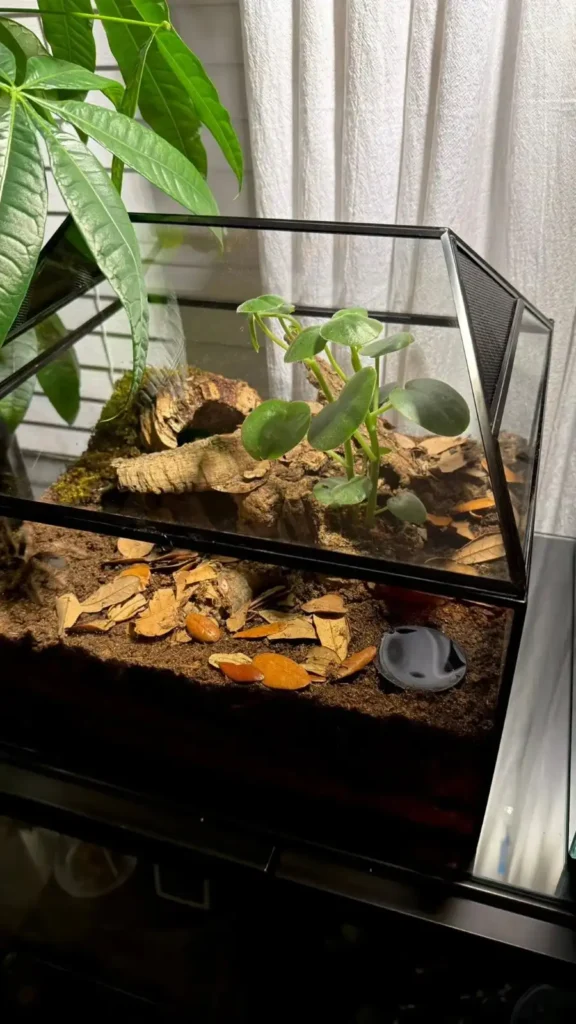
An adult Curly Hair needs a horizontal enclosure — wider than it is tall — with floor space equivalent to a 5–10 gallon tank. Purpose-built terrestrial tarantula enclosures with front-opening doors are ideal, but modified storage containers with drilled ventilation holes work just as well.
Fill the enclosure halfway with substrate — this gives 4–5+ inches of burrowing depth while keeping the fall distance manageable. Tarantulas have fragile abdomens, and a fall from even a few inches onto a hard surface can be fatal.
Include a sturdy hide (a half-cork-bark round is the gold standard), a shallow water dish that’s heavy enough not to tip over, and some natural-looking décor if you want aesthetics. Avoid anything too tall that the spider could climb and fall from.
A note on ventilation: Cross-ventilation (holes on opposite sides of the enclosure) is better than just having holes in the lid. And if you’re using a mesh screen lid, be aware that tarantula feet can get caught in fine mesh, potentially causing leg injuries. Some keepers replace mesh lids with acrylic panels that have small drilled holes.
Bioactive vs. Standard Setup
Bioactive enclosures — setups that include a cleanup crew of springtails and isopods, live plants, and self-sustaining substrate — are growing in popularity. They reduce maintenance by having microfauna break down waste and uneaten food. If you go this route, use a tropical bioactive substrate blend, add springtails as your cleanup crew, and choose hardy plants that can tolerate being bulldozed by a burrowing tarantula.
Standard setups work perfectly fine and are simpler to manage. Either approach keeps a Curly Hair healthy — it’s a matter of personal preference and how much setup time you want to invest upfront.
Temperature, Humidity, and the Lighting Debate
Temperature
Keep ambient temperatures between 70–80°F (21–27°C). Room temperature in most homes falls within this range, so supplemental heating is usually unnecessary. If your home drops below 68°F at night, a low-wattage heat mat attached to the side (never the bottom) of the enclosure can help. Always use a thermostat with any heat source. Avoid placing the enclosure in direct sunlight, near heating vents, or in drafty areas. Temperature stability matters more than hitting a precise number.
Humidity
This is where many new keepers overthink things. The Tliltocatl albopilosus comes from relatively dry scrubland and does not need a tropical rainforest inside its enclosure. Don’t chase an exact hygrometer reading — this species does perfectly well kept on the drier side with constant access to water.
The best approach is the moisture gradient method: keep the top layer of substrate dry while maintaining slight dampness in the deeper layers. You achieve this by pouring a small amount of water into one corner of the enclosure every one to three weeks. The water seeps down, creating a gradient that lets the tarantula choose its preferred moisture level by burrowing deeper or staying near the surface.
A full water dish is the single most important humidity tool. It provides drinking water and passively raises local humidity through evaporation. Keep it clean and full at all times.
Common humidity mistakes: Misting the entire enclosure until the substrate is visibly wet, using a substrate that doesn’t drain well and becomes waterlogged, and sealing the enclosure too tightly without adequate ventilation. All of these promote mold and bacterial growth — a bigger threat to your tarantula than slightly low humidity.
The UVB Lighting Debate
Most tarantula keepers don’t use any special lighting, and Curly Hairs have been successfully kept for decades without UVB. These are nocturnal animals that actively avoid bright light.
That said, there’s emerging discussion that some invertebrates may benefit from low-level UVB exposure. If you want to experiment, a compact coil 5.0 UVB bulb placed on top of a mesh lid — providing a gentle UV gradient with plenty of shaded retreat space — is the most conservative approach. Never force UV exposure on a tarantula without giving it a way to escape the light entirely. For most keepers, ambient room lighting on a natural day/night cycle is all you need.
Feeding Your Curly Hair Tarantula
What to Feed
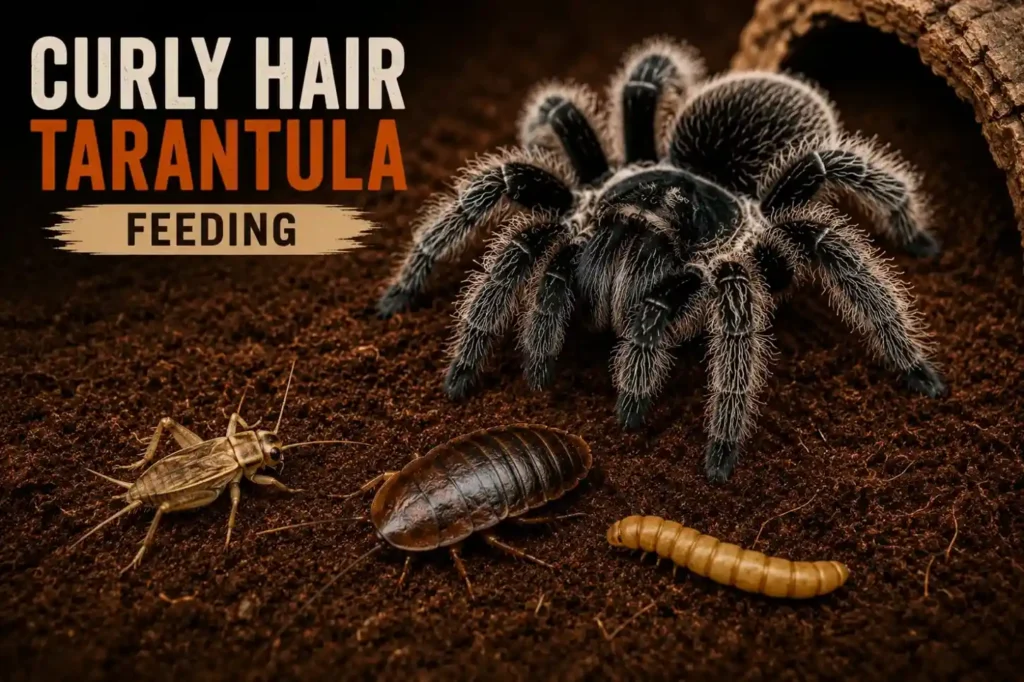
Curly Hairs are opportunistic insectivores and aren’t picky eaters. Core feeder options include crickets (widely available and inexpensive), dubia roaches (nutritious, don’t smell, can’t climb smooth surfaces), mealworms and super worms (good variety feeders), and waxworms (high-fat treat — use sparingly).
The nutrition hack most care sheets skip: Gut-load your feeders 24 hours before offering them. Feed the crickets or roaches fresh vegetables — carrots, leafy greens, apple slices, sweet potato — so your spider gets indirect nutrition from a well-fed prey item. This matters more than most keepers realize, especially for growing slings and juveniles.
How Often to Feed — By Age
- Spiderlings: Twice a week with appropriately sized prey — flightless fruit flies, pinhead crickets, or tiny roach nymphs. Pre-kill any prey larger than two-thirds the sling’s body size. Remove uneaten food after 24 hours.
- Juveniles: Every 7–10 days. Offer 2–3 small-to-medium crickets or a medium dubia roach.
- Adults: Every 2–3 weeks. Offer 4–5 large crickets or one large dubia roach. Some keepers feed as infrequently as once a month — healthy adults don’t need to eat often.
The Abdomen-to-Carapace Rule — Your Visual Feeding Guide
This is the single most useful feeding metric no beginner care sheet teaches clearly. Look at your tarantula from above and compare the width of the abdomen (the large rear section) to the width of the carapace (the front body plate where the legs attach).
- Abdomen thinner than carapace: Underweight. Feed more frequently and offer slightly larger prey.
- Abdomen roughly equal to carapace: Healthy weight. Maintain your schedule.
- Abdomen noticeably wider than carapace: Overweight. Reduce feeding immediately.
Why it matters: an overly distended abdomen is more vulnerable to rupture from even a short fall — often fatal. Excess weight also makes molting harder and increases the risk of a deadly stuck molt. When in doubt, underfeed slightly. A slim tarantula is a healthy tarantula. These animals are adapted to irregular feeding and can go weeks without food as adults with no ill effects.
Understanding Molting
Molting is how tarantulas grow. They shed their entire exoskeleton — including the lining of their mouth, book lungs, and even their stomach — and emerge slightly larger with a soft new exterior that hardens over the following days. It’s remarkable, and it’s also the most dangerous period in your tarantula’s life.
Pre-Molt Signs
Your tarantula is probably approaching a molt if you notice several of these: it stops eating (for days or weeks), its activity level drops, its abdomen appears darker or duller than usual, it lays down a flat mat of silk (a “molt mat”), and it may seal itself inside its burrow. Don’t panic — pre-molt fasting is completely normal and not a sign of illness.
During the Molt
When molting begins, you’ll typically find your tarantula lying on its back. This is normal. Do not touch it, do not try to help it, and do not offer food. The process can take anywhere from 15 minutes to several hours. Make sure humidity is adequate — slightly dampening the substrate in one area can help the old exoskeleton separate cleanly. Keep the enclosure dark and free from vibration.
Post-Molt Care
After your tarantula has flipped back over and is standing upright, resist the urge to feed it. The new exoskeleton is soft and needs time to harden. Wait until the fangs have turned solid black — when they first emerge after a molt, they’re white or translucent and gradually darken.
Recommended post-molt feeding waits: slings 24–48 hours, juveniles 3–7 days, adults 5–10 days. Remove the shed exoskeleton (the “exuvium”) after your spider moves away from it. Save it if you like — you can use it to determine your tarantula’s sex.
How to sex from the molt: Lay the exuvium flat and examine the underside of the abdomen between the front pair of book lungs under magnification. Females have a flap-like structure (the spermathecae) in this fold; males lack it. Fresh molts are easiest to read while still pliable.
Stuck Molt — When to Worry and What to Try
A stuck molt (also “dysecdysis”) happens when parts of the old exoskeleton don’t separate cleanly. It can be caused by dehydration, low humidity, or the spider being disturbed. Signs include struggling for several hours with visible difficulty, and old exoskeleton remaining attached to legs or abdomen.
If you suspect a stuck molt, gently increase humidity by dampening the substrate nearby — do not spray the tarantula directly. Some experienced keepers use a damp cotton swab to very carefully moisten the stuck area. This is delicate work; if you’re not confident, contact your exotic vet or an experienced keeper. Prevention — proper humidity and constant water access — dramatically reduces the risk.
Behavior, Temperament, and the Handling Debate
Decoding Your Curly Hair’s Body Language
The Curly Hair is consistently described as “docile” — and compared to most species, that’s accurate. But “docile” doesn’t mean “friendly.” Your tarantula tolerates you; it doesn’t enjoy you.
Calm behavior: sitting still in the open, slowly walking around, calmly retreating to a hide, laying down web.
Stressed/defensive behavior: slapping the front legs down rapidly (“drumming”), raising the front legs in a threat pose, turning the abdomen toward you (preparing to kick hairs), flicking urticating hairs, and excessive burrowing after disturbance.
Young Curly Hairs are noticeably more skittish than adults. They may bolt, burrow frantically, or kick hairs at the slightest disturbance. This is normal and not aggression — they’re small and vulnerable. They typically calm down significantly as they mature.
Understanding Urticating Hairs
As a New World tarantula, T. albopilosus has patches of urticating hairs (Types I and III) on its abdomen — barbed, microscopic bristles it can kick off when threatened. On skin, they cause itching, redness, and mild irritation that resolves within a few hours to a couple of days. In the eyes, irritation is significantly worse and can require medical attention.
First aid: For skin, wash gently with soap and water; avoid scratching (it pushes barbs deeper); OTC hydrocortisone cream helps itching. For eyes, flush with clean water immediately and see a doctor if irritation persists.
The Handling Question
Can you handle a Curly Hair? Yes — this species is among the most tolerant in the hobby. Should you? That depends on your goals.
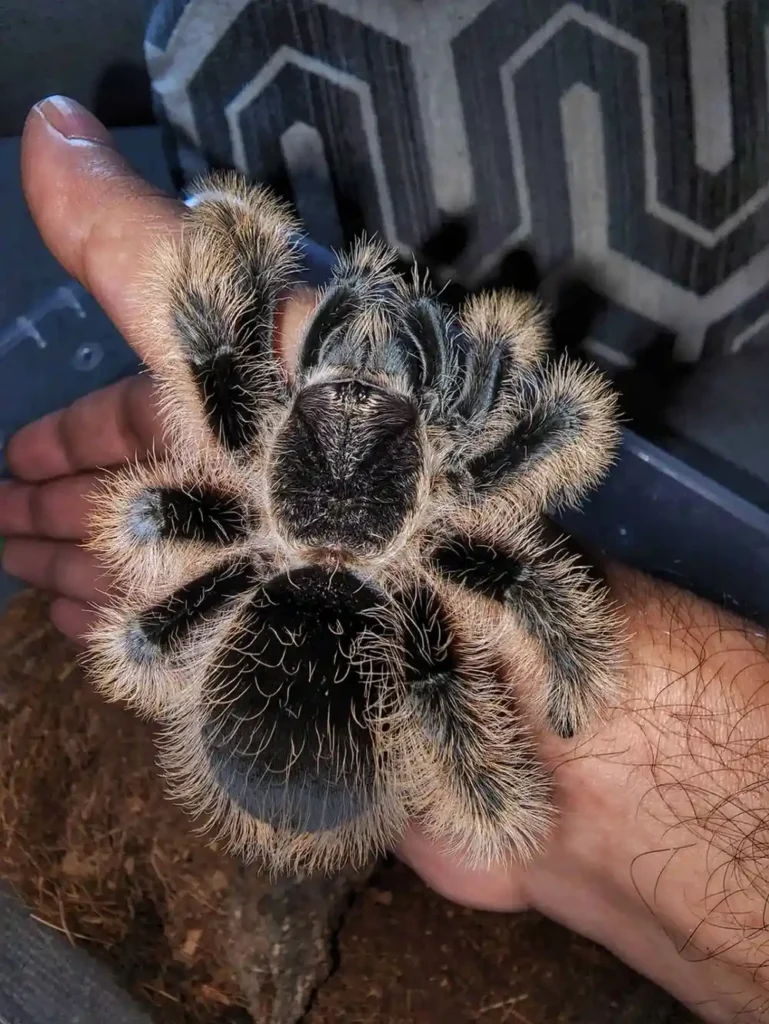
Handling provides zero benefit to the tarantula. Spiders don’t bond with owners, don’t recognize your voice or scent, and don’t derive comfort from being held. Handling is entirely for the keeper. If you do it, go in with safety precautions: always handle over a soft surface (a fall from hand height onto a hard floor can rupture the abdomen), move slowly, let the tarantula walk onto your hand rather than grabbing it, and keep sessions brief. If your spider threat-poses, kicks hairs, or bolts, put it back and try another day.
If you’re allergic to bee stings or insect venom, exercise extra caution. Bites are rare but possible, and the venom — while medically insignificant for most people — produces a bee-sting-like reaction. Those with severe insect venom allergies should consult an allergist before handling any tarantula. if you have any other tarantula like Goliath birdeater and rose hair tarantula , then you can click on article for more useful information .
Health Issues and Troubleshooting
Curly Hairs are hardy, but “hardy” doesn’t mean invincible.
Dehydration
Signs: a shrunken, wrinkled abdomen, lethargy, and positioning over the water dish for long periods. Fix it by keeping the dish always full and clean, slightly dampening the substrate, and gently dripping water near (not on) the spider. Severely dehydrated tarantulas sometimes need a shallow “ICU” setup — a small container lined with damp paper towels and a water dish, kept dark and quiet.
Mites and Parasites
Small moving dots may be mites. Grain mites (attracted to leftover food) are annoying but largely harmless; parasitic mites can weaken your spider. Remove all uneaten prey promptly, keep the enclosure clean, and if mites persist, do a full substrate change and enclosure scrub-down.
Nematodes — tiny parasitic worms, sometimes visible as small white worms around the mouth area — are far more serious and often fatal. If you suspect them, consult an exotic vet immediately. Prevention means buying captive-bred specimens from reputable sources and quarantining new additions.
“My Tarantula Won’t Eat”
The most common concern new keepers have — and usually your tarantula is fine. Ask in order: Is it in pre-molt (dark coloration, web mat, reduced activity)? Has anything changed recently (rehousing, temperature swings, vibrations)? Is the water dish full (dehydration suppresses appetite)? Is the prey appropriately sized? If an adult refuses food for more than four weeks with no pre-molt signs and proper husbandry, consult an experienced keeper or exotic vet.
Abdomen Injury or Rupture
A ruptured abdomen — from falls, impact, or even minor bumps in obese tarantulas — is a life-threatening emergency. You’ll see hemolymph (clear or bluish fluid) leaking from a tear. Emergency response: apply a small amount of cornstarch or liquid bandage (like New-Skin) to help seal the wound, keep the spider in a clean, quiet ICU setup, don’t feed until it seals, and contact an exotic vet. Recovery is possible but not guaranteed — prevention through proper enclosure height, avoiding obesity, and careful handling is always better.
Breeding Tliltocatl albopilosus
Breeding Curly Hairs is one of the more accessible projects in the hobby, but it still requires preparation.
Sexual maturity: Males mature in 2–3 years, identifiable by tibial hooks (spurs on the front legs) and bulbous pedipalps. Females mature at 3–4 years and are generally larger and heavier-bodied.
Pairing: Make sure the female is well-fed before introducing the male — a hungry female is more likely to treat her suitor as dinner. Introduce the male into the female’s enclosure in the evening. The male performs courtship drumming; if the female is receptive, she may respond with her own vibrations or remain still. After successful copulation, remove the male immediately — post-mating cannibalism is a real risk.
Egg sac and slings: A fertilized female typically produces an egg sac 4–8 weeks after mating. Maintain 75–80°F and 65–75% humidity with good ventilation to prevent mold. Sacs can contain 300–500+ eggs. Some breeders pull the sac after 30–40 days for artificial incubation; others leave it with the mother. Slings usually emerge within 6–8 weeks. Raising hundreds of slings requires real space, time, and feeder supply — plan ahead.
Why it matters: Every captive-bred Curly Hair is one less spider taken from the wild. T. albopilosus is CITES-listed precisely because of historical overcollection, so breeding responsibly and buying captive-bred is a genuine conservation contribution.
Cleaning and Long-Term Maintenance
Regular maintenance: Remove uneaten prey within 24 hours — leftovers attract mold, mites, and grain beetles. Spot-clean visible feces or boluses (the leftover ball of prey remains the spider discards after feeding). Keep the water dish clean and full, wiping and refilling every few days.
Deep cleaning: Every 6 months — or whenever the enclosure looks or smells “off” — do a full substrate change. Rehouse the tarantula temporarily into a secure holding container, remove all old substrate and décor, scrub the enclosure with warm water (no soap or chemicals), let it dry completely, and rebuild with fresh substrate. Bioactive enclosures need this less often, since the cleanup crew handles much of the waste.
Frequently Asked Questions
Are curly hair tarantulas good for beginners?
Yes — they’re widely considered the single best species for first-time owners. Their docile temperament, hardy constitution, low maintenance, and forgiving nature make them ideal for learning tarantula husbandry without high stakes.
How long do curly hair tarantulas live?
Females can live 20–25 years in captivity with proper care. Males have a much shorter lifespan of about 4–5 years, with most dying within a year or so of maturity. This difference is normal across most tarantula species.
How big do curly hair tarantula get?
Adults reach a diagonal leg span of about 5.5–6.5 inches (14–17 cm), with a body length around 3 inches. Females tend to be heavier-bodied; mature males are leggier and slightly smaller overall.
Do curly hair tarantula bite?
Bites are rare — the species strongly prefers to retreat or kick hairs. If a bite occurs, it’s comparable to a bee sting for most people, with localized pain and swelling that resolves within a day or two. The venom is not medically significant for healthy adults.
Are curly hair tarantulas poisonous or venomous?
They’re venomous, not poisonous — but the venom is extremely mild, comparable to a bee sting, and not dangerous to healthy adults.
Can you hold a curly hair tarantula?
Yes — this species is among the most handling-tolerant available. Handle over a soft surface, with slow movements, for brief periods. The tarantula gains no benefit from being held, so always watch for stress and respect its boundaries.
Are curly hair tarantula friendly / docile?
They’re very docile — slow-moving, relaxed, and rarely defensive as adults. But “docile” isn’t “friendly”: they don’t bond with owners, they simply tolerate handling without aggression. Slings are more skittish and calm down as they mature.
Are curly hair tarantulas nocturnal?
Yes — they’re most active at night and rest during the day. No special lighting is required.
Do curly hair tarantulas hibernate?
No. They may go through long inactive periods before a molt or during cooler months, but this isn’t true hibernation — it’s normal behavior.
How much does a curly hair tarantula cost?
Spiderlings cost $15–$30, juveniles $30–$60, and adult females $50–$80+. Initial enclosure setup runs $50–$120, and monthly feeder costs are about $5–$15.
Final Thoughts
If you’ve made it this far, you already know more than most people who bring home their first tarantula. And that puts you ahead of the game. The Curly Hair Tarantula isn’t flashy. It won’t do tricks. It won’t greet you at the door. But there’s something genuinely satisfying about watching a creature you’ve cared for properly — sitting calmly in an enclosure you built, webbing up its cork bark, slowly stalking a cricket like it’s the most important thing in the world.
This is the spider that teaches you how to be a good keeper. It won’t punish you for small mistakes the way a more sensitive species would. It gives you room to learn, adjust, and grow alongside it. My honest advice? Set up your enclosure before you buy the spider. Find a reputable breeder. Start with a sling if you want the full experience of watching it grow — or grab a juvenile if you’d rather skip the tiny deli-cup stage. Either way, you’re getting a pet that could be with you for the next two decades.