Davus pentaloris: The Complete Guatemalan Tiger Rump Tarantula Care Guide
Last updated: April 2026 | Reviewed for accuracy against current taxonomic records
Quick Facts Table
| Attribute | Detail |
| Scientific name | Davus pentaloris |
| Common name | Guatemalan Tiger Rump |
| Family | Theraphosidae |
| Subfamily | Theraphosinae |
| Native range | Guatemala, southern Mexico (Chiapas region) |
| Habitat type | Tropical forests, humid grasslands |
| Adult leg span | 4 – 4.75 inches (10 – 12 cm) |
| Body length | ~2 inches (5 cm) |
| Growth rate | Fast |
| Lifespan (female) | 10 – 11 years |
| Lifespan (male) | 2 – 3 years |
| Temperament | Skittish, generally docile |
| Urticating hairs | Yes (Type III) |
| Experience level | Intermediate |
| Ideal temperature | 68 – 76°F (20 – 24°C) |
| Ideal humidity | 65 – 75% |
| Diet | Crickets, roaches, mealworms |
What Is Davus pentaloris?
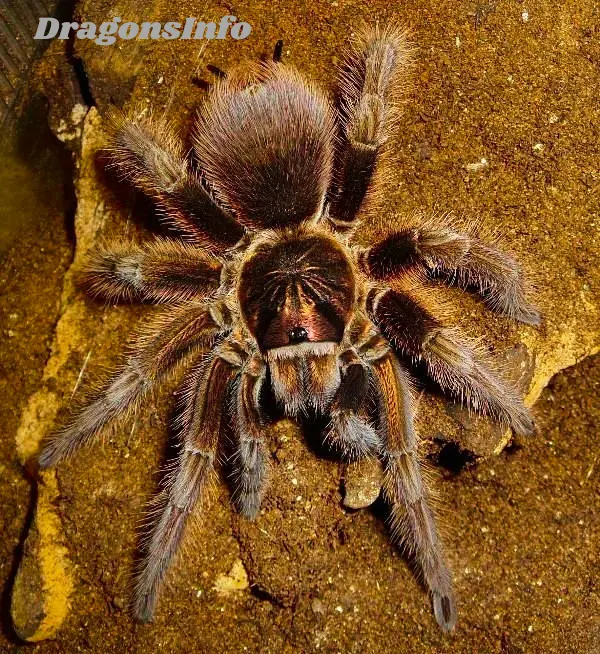
Davus pentaloris is a New World terrestrial tarantula — one of the most eye-catching species in the hobby. If you’ve ever scrolled through tarantula photos and stopped on one with a glossy copper carapace and bold black-and-orange tiger stripes across its abdomen, there’s a good chance you were looking at a Guatemalan Tiger Rump.
It’s not a giant. Adults cap out around 4.75 inches across the legs, which puts it firmly in the small-to-medium range. But what it lacks in size, it makes up for in color, activity, and that addictive “always doing something” personality that many larger species just don’t have.
People keep this tarantula for three main reasons:
- It looks unreal. Few species match its contrast and patterning.
- It grows fast. You’ll see it change month to month, especially as a sling.
- It’s affordable and available. Captive-bred slings are common in the US and EU hobby.
The catch? It’s fast. Really fast. And while it won’t try to bite you, it will absolutely bolt out of an enclosure the second you crack the lid. This is the main reason most keepers recommend it for intermediate keepers rather than absolute beginners.
Taxonomy and Naming History
Davus pentaloris has had a confusing past. Here’s the short version.
The species was originally described in 1875 and has been shuffled between genera more than once. For decades, it lived under Cyclosternum pentalore — a name you’ll still see in older books, forum posts, and even some pet store tags. In 2017, taxonomists moved it (along with a handful of related species) into the genus Davus, which is where it sits today.
Why does this matter for keepers? Because if you’re searching for care information, you might run into old articles about Cyclosternum pentalore. Those are about the same animal. The care hasn’t changed — just the label.
Current accepted classification:
| Rank | Name |
| Kingdom | Animalia |
| Phylum | Arthropoda |
| Class | Arachnida |
| Order | Araneae |
| Family | Theraphosidae |
| Subfamily | Theraphosinae |
| Genus | Davus |
| Species | D. pentaloris |
The genus name Davus comes from Latin (historically used as a common slave’s name in Roman literature — a quirk of taxonomic naming rather than anything biologically meaningful). The species epithet pentaloris refers to the patterning on its legs and abdomen — roughly, “five-striped.”
Natural Habitat and Range
Guatemalan Tiger Rumps live across a band of Central America covering Guatemala and parts of southern Mexico, especially Chiapas. Their natural environment is tropical forest and humid grassland — warm year-round, with a pronounced wet season and high ambient moisture in the leaf litter.
They’re not deep burrowers. In the wild, they’re opportunistic terrestrials — meaning they’ll grab whatever hiding spot they can find rather than excavate their own elaborate tunnel system. A fallen log, a gap under a rock, an abandoned rodent burrow, a thick pile of leaf litter. Anything dark and humid works.
Understanding this matters for captive care. You don’t need to give them three feet of substrate to dig into. You do need to give them a good hide and decent ground moisture.
Key habitat facts:
- Elevation: roughly sea level to 1,500 meters
- Annual rainfall: heavy, with a defined wet season
- Ambient temperature: mild tropical, rarely above 80°F
- Shelter: leaf litter, logs, root tangles, abandoned burrows
Appearance and Identification
If you put a Davus pentaloris next to ten other tarantulas, you could probably pick it out blindfolded.
The key visual features:
- Coppery or bronze carapace that almost looks metallic in the right light
- Dark, nearly black legs that contrast sharply with the carapace
- Bold black-and-orange (or rust) striping across the abdomen — the “tiger rump” look
- Small body — adults are only about 2 inches in body length
Males and females look similar as juveniles. Once they mature, males develop longer, thinner legs, visible tibial hooks, and bulbous pedipalps used for sperm transfer. Mature males also lose some of their vibrant color and take on a grayer, dustier appearance.
How to tell it apart from its cousin, Davus fasciatus:
D. fasciatus (Costa Rican Tiger Rump) is often mistaken for D. pentaloris. The fasciatus is darker overall, with less vibrant orange striping, and comes from Costa Rica rather than Guatemala. Price is usually a giveaway too — D. pentaloris is typically cheaper and more widely available.
Temperament and Behavior
Let’s be real about what keeping this tarantula actually feels like.
Davus pentaloris is skittish, not defensive. There’s a big difference. A defensive tarantula stands its ground, rears up, shows fangs, and kicks hairs. A skittish one runs. D. pentaloris is firmly in the second camp — its first, second, and third response to anything it doesn’t like is to sprint for cover.
For a keeper, this means:
- They’re fast. Not Old World “disappeared before you saw it” fast, but still very quickly.
- They’re unpredictable. A calm-looking tarantula can bolt the moment you move a water dish.
- They’re not heavy hair-kickers. They have urticating hairs (Type III), but use them less than, say, a Grammostola or Tliltocatl.
- They web a lot. Expect thick webbing around the hide, across the substrate, and sometimes up the walls.
- They’re active. Unlike some terrestrials, which hide 95% of the time, D. pentaloris often comes out to hunt, patrol, and rearrange its webbing.
That activity is a huge part of the appeal. You actually see this tarantula doing things.
Biting risk: low. They’d rather run. But if cornered, they can and will bite. The venom is considered medically insignificant to healthy adults — similar to a bee sting for most people — but exposure to hair can cause skin irritation. Never rub your eyes after opening the enclosure without washing your hands.
Is it beginner-friendly?
Short answer: close, but not quite.
This species sits in the gray zone between beginner and intermediate. Here’s the honest breakdown:
Reasons it’s beginner-friendly:
- Hardy and forgiving about minor husbandry mistakes
- Strong appetite — almost never refuses food outside of premolt.
- Fast growth, so you see progress quickly.
- Doesn’t need fancy heating or lighting.
- Common and affordable as a captive-bred sling.
Reasons it’s not quite beginner:
- Speed is the big one. If you’ve never worked with a fast tarantula, your first rehouse can go sideways in a hurry.
- Escape risk is real — always do maintenance with the enclosure inside a larger catch container for the first few months.
- Type III urticating hairs can be irritating, especially for people with sensitive skin.
If your first tarantula was a Grammostola pulchra, Tliltocatl albopilosus, or Brachypelma hamorii, and you’re comfortable with them, D. pentaloris is a great second or third species. If you’ve literally never kept a tarantula, start slower.
Comparison With Similar Species
How does Davus pentaloris stack up against other popular intermediate tarantulas?
| Feature | Davus pentaloris | Tliltocatl albopilosus | Brachypelma hamorii | Davus fasciatus |
| Leg span | 4.75″ | 6″ | 6″ | 4.5″ |
| Growth rate | Fast | Medium | Slow | Fast |
| Temperament | Skittish | Docile | Docile | Skittish |
| Display activity | High | Medium | Low | High |
| Webbing | Heavy | Moderate | Light | Heavy |
| Price (sling) | $20 – $40 | $15 – $30 | $40 – $80 | $30 – $60 |
| Origin | Guatemala | Honduras/Nicaragua | Mexico | Costa Rica |
| Best for | Intermediate | Beginner | Beginner | Intermediate |
Takeaway: If you want speed and color, get pentaloris. If you want a chill, hand-friendly first tarantula, get Tliltocatl albopilosus. If you want a bulletproof showpiece, get Brachypelma hamorii.
Enclosure Setup
Set up changes as your tarantula grows. Here’s what each life stage needs.
Spiderlings (0.25″ – 1″)
Slings are tiny. A 32 oz deli cup or a small acrylic sling enclosure (around 3″×3″×4″) is more than enough.
What goes inside:
- Substrate filled about two-thirds of the way up (coconut fiber or a quality pre-made mix works)
- One small cork bark piece or a flat stone as a hide
- A tiny water source — a bottle cap or a few drops on one corner of the substrate weekly
- Ventilation holes on the side, not just the top, to prevent mold
Keep the substrate slightly damp but not soaking. If you squeeze a handful and water drips out, it’s too wet.
Juveniles (1″ – 3″)
Move up to something around 5″×5″×5″. A standard acrylic cube or a pasta sauce jar (properly ventilated) works.
What goes inside:
- Substrate 3 – 4 inches deep
- Cork bark hide — half round or slab propped at an angle.
- Small water dish (a bottle cap is fine for the first jump up)
- One dry corner, one slightly damp corner
At this stage, they start building serious webbing. Don’t clean it out unless it’s moldy. That web is how they feel safe.
Adults (3″+)
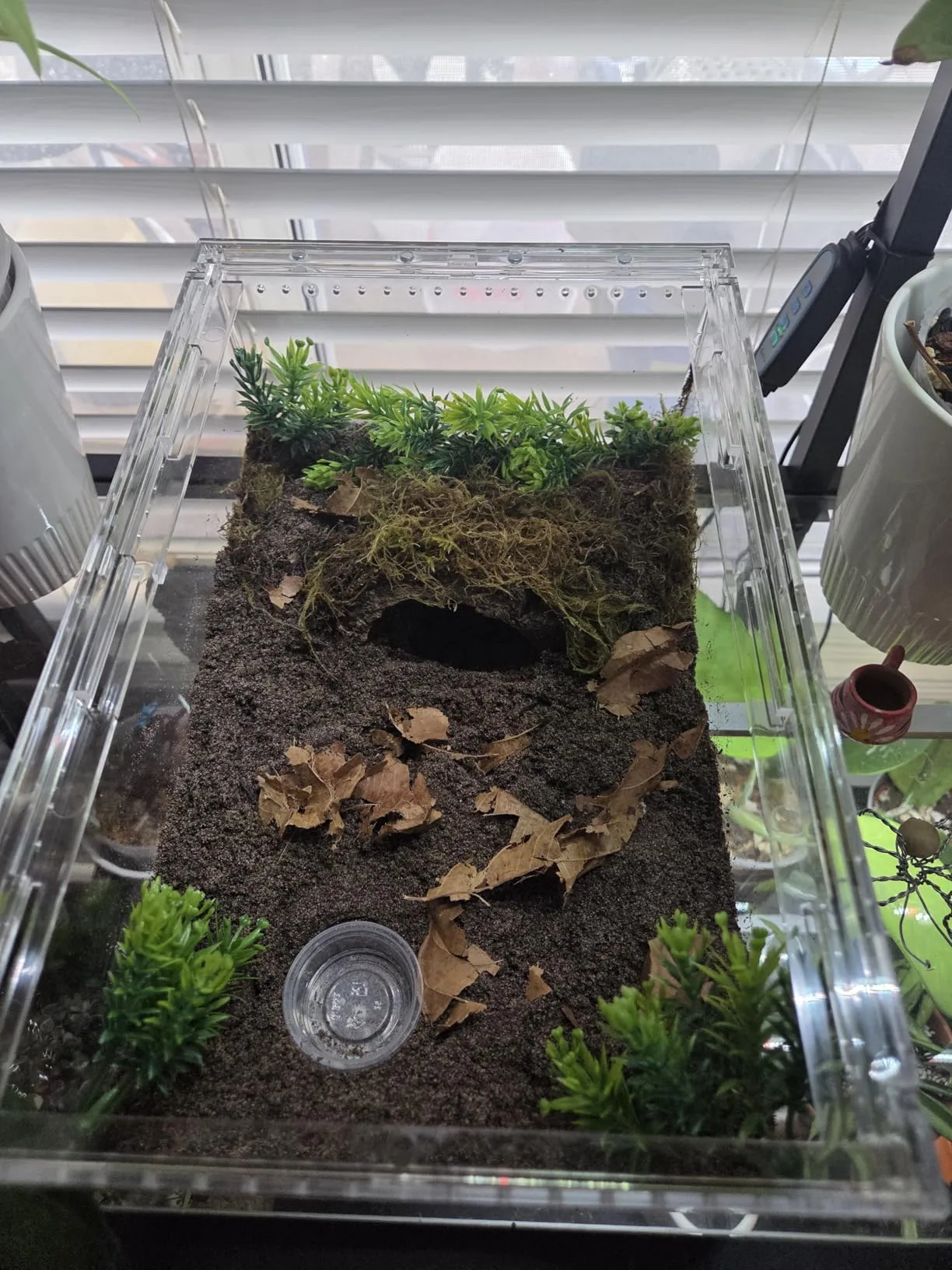
Final enclosure is typically around 10″×10″×8″ — horizontal orientation matters more than vertical for this species.
What goes inside:
- 4 inches of substrate, packed firm enough to hold a burrow but loose enough to dig
- One large cork bark hide, positioned to create a cave-like shelter.
- Water dish (shallow, always full)
- Optional: leaf litter, sphagnum moss clumps for aesthetics and microclimate.
- Secure lid — check every gap against your tarantula’s body width.
Tarantulas can fit through any gap their carapace can pass through. If the lid has even a pencil-width gap, assume your tarantula will find it.
What NOT to do:
- Don’t use a tall arboreal-style enclosure. This is a ground species.
- Don’t use sand or gravel substrate. They can’t burrow, and it holds no moisture.
- Don’t use heat lamps. Room temperature is fine in almost every home.
- Don’t skip the hide. Without one, they stress.
Temperature and Humidity
This is where many new keepers overthink things.
Temperature: 68 – 76°F (20 – 24°C). That’s normal room temperature in most homes. You probably don’t need a heater. If your room drops below 65°F for extended periods in winter, a small space heater in the room (not in the enclosure) is the safest option.
Humidity: roughly 65 – 75%, though you don’t need to obsess over a hygrometer. The practical rule is:
- Keep the lower half of the substrate slightly damp at all times.
- Let the top surface dry out between waterings.
- Keep the water dish full.
- Overflow one corner of the substrate once every week or two.
That’s it. Tarantulas drink from the dish, not from airborne moisture. “Humidity” for them is really about substrate moisture.
Signs you’re too dry: curled legs, lethargy, a spider sits on the water dish.
Signs you’re too wet: mold on substrate or hide, mites, fungus gnats.
Feeding Guide
Davus pentaloris has one of the most enthusiastic feeding responses in the hobby. They pounce on prey as something possessed. It never stops being fun.
Slings
- Frequency: twice a week
- Prey: flightless fruit flies, pinhead crickets, pre-killed small mealworm sections, or confused flour beetles
- Rule: prey should be no bigger than the sling’s body
- Uneaten prey: remove after 24 hours — crickets will chew on a molting spider
Juveniles
- Frequency: once every 7 – 10 days
- Prey: 2 – 3 small crickets, or one medium dubia roach
- Body check: if the abdomen looks smaller than the carapace, feed more; if it’s noticeably larger, feed less
Adults
- Frequency: every 2 – 3 weeks
- Prey: 3 – 5 large crickets, or one large dubia roach
- Water: always available, changed weekly
The abdomen rule
Watch your tarantula’s abdomen relative to its carapace (the shield-like top of the front body):
- Abdomen thinner than carapace width: underfed. Increase frequency.
- Abdomen about 1.5× carapace width: perfect.
- Abdomen larger than 2× carapace width: overfed. A fall can rupture it. Cut back.
After a molt
Don’t feed right after a molt. The fangs are soft and white. Wait:
- Slings: 3 – 5 days
- Juveniles: 5 – 7 days
- Adults: 7 – 14 days
You’ll know they’re ready when the fangs have darkened to solid black.
Molting
Molting is the scariest thing for new keepers and, honestly, the most routine thing for the tarantula.
Signs a molt is coming:
- Refusing food for 1 – 3 weeks
- Dark patch on the abdomen (visible through the hairs)
- Sealing off the hide with webbing
- Sitting very still for long stretches
Do not disturb during a molt. No feeding, no misting directly on the spider, no moving things around. The molt itself takes anywhere from 15 minutes (in slings) to several hours (in adults). The tarantula flips onto its back — this is normal, not death.
After molting, the exoskeleton is soft. Do not feed during the waiting period above. Do make sure fresh water is available, because rehydration is the first priority after a molt.
Molt frequency by age:
- Slings: every 3 – 6 weeks
- Juveniles: every 2 – 4 months
- Adults: once a year (females) or final molt, then mature (males)
Handling
Should you handle a Davus pentaloris?
No.
Not because they’re dangerous — they aren’t, particularly — but because:
- They’re fast, and you will lose control.
- A fall from hand height can rupture their abdomen and kill them.
- Their urticating hairs can irritate your skin or eyes.
- There’s no benefit to the tarantula.
Watching them hunt, web, and explore their enclosure is the whole point. You don’t need to pick them up to enjoy them. If you want a tarantula you can handle occasionally, a mature female Grammostola pulchra is a far better choice.
Breeding
Captive breeding of Davus pentaloris is relatively straightforward, which is part of why they’re so widely available. Here’s how it works.
Sexing
- Males mature at 2 – 3 years with tibial hooks and bulbous pedipalps.
- Females mature at 3 – 4 years.
- Ventral sexing can be done from the shed exuviae under magnification.
Pairing
- Feed the female well for 2 – 3 weeks before pairing so she’s less likely to view the male as food.
- Introduce the male in the female’s enclosure at night (they’re nocturnal)
- Watch for drumming — the male taps his legs on the substrate to signal.
- If the female is receptive, she’ll drum back or stay still.
- Remove the male immediately after mating.
Egg sac
- Fertilized females typically produce an egg sac 4 – 6 weeks after mating.
- Egg sacs contain 100 – 300 eggs.
- Keep ambient temps at 75 – 80°F and humidity at 70%
- Spiderlings emerge after 6 – 8 weeks if left with the mother.
- Some breeders pull the sac at 30 – 40 days for controlled incubation.
Raising slings
- Separate into individual vials once they hit the second instar.
- Feed flightless fruit flies or pinhead cricket parts every 3 – 4 days.
- Expect losses in the first few instars — this is normal.
Troubleshooting
Real problems keepers run into, and what to do about them.
Tarantula hasn’t eaten in three weeks.
Usually premolt. Check the abdomen — if it looks dark or shiny, a molt is coming. Leave it alone. Only worry if it’s been over two months and the abdomen is shrinking.
Tarantula is sitting on the water dish.
Dehydrated. Check that the dish is full and that the substrate has a damp patch. Overflow one corner slightly.
White fuzz on the substrate.
Mold. Remove the affected patch, add more ventilation, and let the surface dry. Persistent mold means you need more airflow, not less moisture.
Tiny bugs are crawling in the enclosure.
Usually, mites or fungus gnats. Springtails and isopods can help. If it’s substrate mites (harmless, but ugly), dry out the enclosure and add ventilation.
Tarantula escaped.
Turn off fans. Close all doors. Put flour on the floor around the room so you can track it. Check dark corners at night with a flashlight — eyeshine reflects. They usually stay close.
The abdomen looks injured.
If you see fluid leaking, apply cornstarch to stop the bleeding and leave the tarantula in a very simple enclosure with deep, clean substrate and water. Recovery is possible but not guaranteed.
Tarantula is upside down.
Almost certainly molting. Do not touch it. Do not flip it back over. Come back in 24 hours.
FAQ
Is Davus pentaloris venomous?
Yes, but its venom is considered medically insignificant to healthy humans. A bite would feel comparable to a wasp sting. Bites are rare because this species runs rather than fights.
How long does Davus pentaloris live?
Females live 10 – 11 years. Males live 2–3 years in total (and usually only 1 year after reaching maturity).
How big does Davus pentaloris get?
Adults reach about 4.5 – 4.75 inches in leg span. Body length is around 2 inches.
How fast does Davus pentaloris grow?
Very fast. Slings can reach juvenile size in 6 – 12 months under good conditions, and adult size in 2 – 3 years.
Can Davus pentaloris be handled?
Technically, yes; practically no. They’re too fast, and the risk of falls for the tarantula is too high. Don’t handle them.
Does Davus pentaloris need a heat lamp?
No. Room temperature (68 – 76°F) is ideal. Heat lamps dry out the enclosure and stress the tarantula.
How often should I feed Davus pentaloris?
Slings twice a week, juveniles every 7 – 10 days, adults every 2 – 3 weeks.
Does Davus pentaloris burrow?
Opportunistically. It prefers to hide under cork bark or use existing cavities rather than dig deep tunnels, but it will dig if the substrate allows.
Is Davus pentaloris the same as Cyclosternum pentalore?
Yes. Cyclosternum pentalore is the old name for this species. It was reclassified into the genus Davus and is now correctly called Davus pentaloris.
How much does Davus pentaloris cost?
Slings typically sell for $20 – $40. Juveniles run $40 – $70. Adult females can reach $100 – $150 depending on the seller and season.
Is Davus pentaloris aggressive?
No. It’s skittish — it runs away from threats rather than standing its ground. Bites are uncommon.
What do I feed Davus pentaloris spiderlings?
Flightless fruit flies, pre-killed pinhead crickets, small dubia roach nymphs, or confused flour beetles.
Does Davus pentaloris need high humidity?
Moderate, around 65 – 75%. Slightly damp substrate with a full water dish is more important than ambient humidity numbers.
Can I keep two Davus pentaloris together?
No. Like nearly all tarantulas, they’re cannibalistic. One per enclosure.
How do I tell if my Davus pentaloris is male or female?
Check the shed exoskeleton. Females have a visible spermatheca on the underside of the abdomen; males do not. Mature males also have tibial hooks on their front legs.
Why is my Davus pentaloris not eating?
Most likely premolt. This is normal. It can also mean temperatures are too low, the tarantula is stressed, or the prey is too large. Try smaller prey in a week; if that fails, leave it alone.
How often does Davus pentaloris molt?
Slings molt every 3 – 6 weeks, juveniles every 2 – 4 months, adults once a year or so.
Where is Davus pentaloris from?
Guatemala and parts of southern Mexico, especially the Chiapas region.
Is Davus pentaloris good for beginners?
It’s best suited to intermediate keepers. Beginners who are comfortable with fast species can handle it, but it’s not a first-tarantula pick.
What’s the difference between Davus pentaloris and Davus fasciatus?
D. pentaloris is brighter with vivid orange-and-black striping and comes from Guatemala. D. fasciatus is darker overall with less contrast and comes from Costa Rica.
Where to Buy
The safest places to buy Davus pentaloris are:
- Licensed invertebrate dealers with published contact info and live-arrival guarantees
- Expo vendors at reputable events (NARBC, Repticon, Hamm, Houten)
- Established hobbyist breeders on forums like Arachnoboards
Avoid:
- Wild-caught specimens (poor condition, ethical issues, often mislabeled)
- Sellers without a visible return/live-arrival policy
- Any price that seems too good to be true — captive-bred slings are not $5 animals
Captive-bred is always the right call. It’s better for the animal, better for the hobby, and better for wild populations in Guatemala and Mexico.
References
For further reading and the primary sources behind this guide:
- World Spider Catalog. Davus pentaloris (Pocock, 1903). Natural History Museum Bern.
- Pocock, R. I. (1903). On some genera and species of South-American Aviculariidae. Annals and Magazine of Natural History.
- Journal of Arachnology — search the archive for recent Theraphosinae taxonomy updates.
- ZooKeys — open-access taxonomic papers on New World theraphosid reclassifications.
- Schultz, S. A. & Schultz, M. J. The Tarantula Keeper’s Guide (3rd edition).
A Final Note
Tarantulas are not toys and they’re not decorations. A Davus pentaloris you buy as a quarter-inch sling today can still be with you when you’re a decade older, if you do right by it. That’s a privilege.
Give it a proper hide. Keep the water clean. Don’t overfeed. Don’t handle. Let it be the weird, fast, beautiful thing it is.
If this guide helped you, share it with the next person getting into the hobby. That’s how the community grows — one well-kept tarantula at a time.